Field Notes
The Ethics of Photographing People in Asia
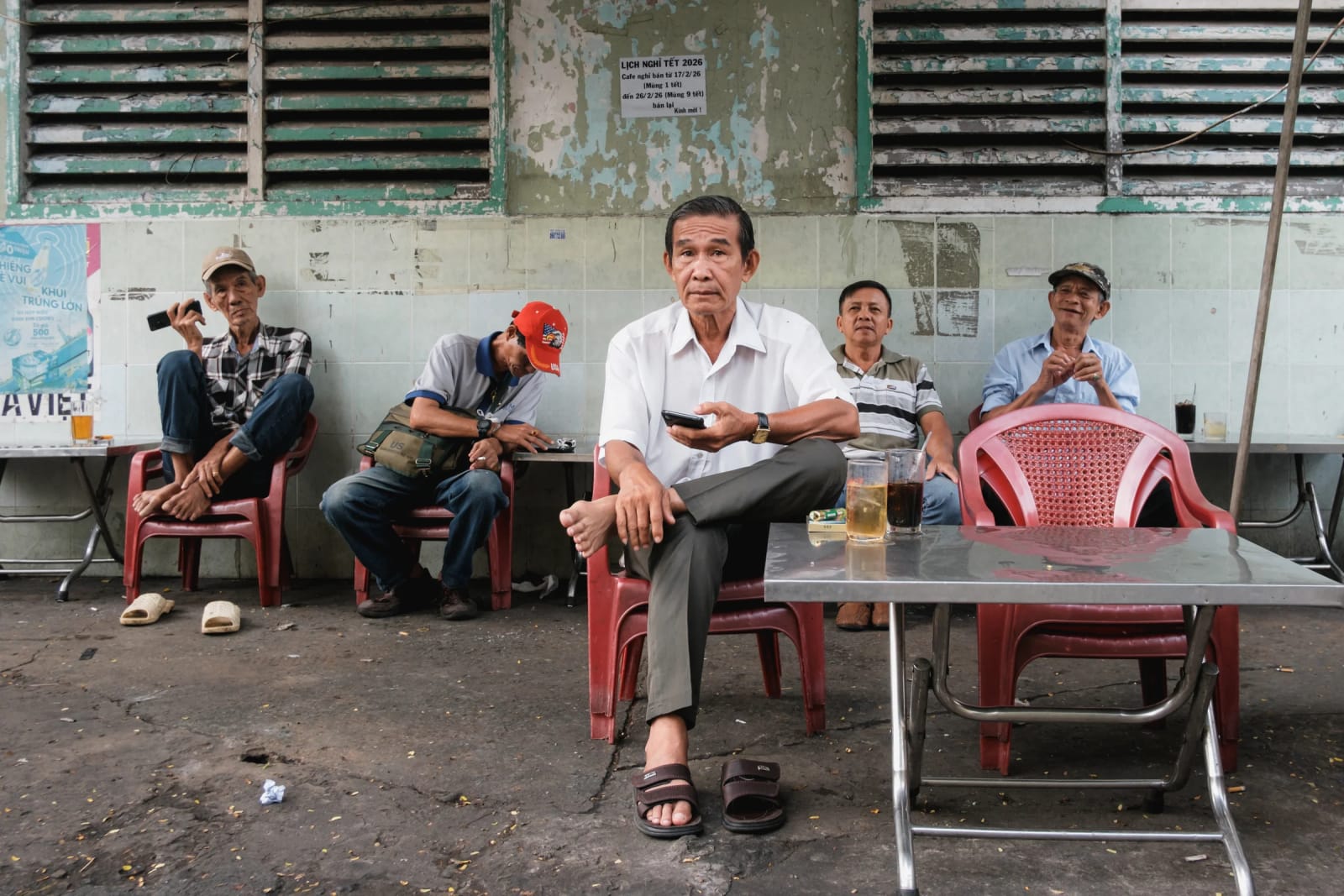
Subjects meeting the lens at a roadside café. Photo by Adrien Jean (@adrienjeanphoto)
There is a half-second on Hàng Bạc when the woman selling bún riêu looks up from her pot and finds your lens already on her. Everything the next frame becomes — a gift or a theft — is decided in that half-second, before the shutter, in what your face does next.
The question the visiting photographer skips
Most of us arrive in Vietnam with the shutter already half-pressed. We have read the light guides, packed the 35mm, learned that the Old Quarter wakes at five. What we rarely pack is the one question that actually decides whether the picture is any good: what do I owe the person in the frame? It gets skipped because it feels like it slows you down, and street photography is supposed to be fast. But the skip is not neutral. A stranger with a camera, pointed at someone's ordinary Tuesday, is a small act of power whether you name it or not.
The uncomfortable version is this: there is a real gap between documenting a place and consuming it. Documenting means you were present to something and carried it out with care. Consuming means you extracted a look — grit, poverty, a conical hat lit from behind — and left nothing, learned nothing, stayed a stranger. The same camera makes both pictures. The difference is never in the gear. This piece takes a position that runs against the drive-by instinct: consent and reciprocity are not constraints on good street photography. They are what make it good.
The same camera makes both pictures. The difference is never in the gear.
Consent is a spectrum, not a form
Consent in the street is not a signed release. It is a reading you make, in real time, of what kind of picture you are actually taking. At one end is the wide public scene — the flow of motorbikes pouring across the Long Biên approach at dusk, a market lane thick with bodies, a café spilling onto the pavement. No one in that frame is the subject; they are the weather of the place. You do not need permission to photograph a crowd any more than you need permission to photograph rain.
At the other end is the close portrait, where one person is the frame. The barber mid-cut on Ngõ Tạm Thương, the old man with the caged birds, the girl watching her mother weigh lychees. When a single human fills your composition and carries its meaning, you have crossed from photographing a place to photographing a person, and a person can be asked. The skill is knowing, before you lift the camera, which of the two you are making. If the answer is a person, the ethical move and the better-photograph move are the same one: engage.
A quick test in the moment: if you removed this individual and the picture collapsed, they are the subject, not the scenery. Subjects get a nod, a smile, a beat of acknowledgement. Scenery does not — but if you find yourself hoping they will not notice, that is usually your own conscience telling you which category you are in.
The power dynamic you are carrying
There is a specific problem that a foreign photographer carries into a Vietnamese street, and pretending it is not there does not make the pictures more honest. The disparity is economic and it is visible. Your camera can cost more than the vendor's month. The frame that reads as gritty authenticity to an audience back home is very often someone's hard, underpaid labour turned into an aesthetic — the cyclo driver's sweat, the recycler's bent back, the flaking colonial wall behind a woman who would rather it were repainted.
The exotic-Vietnam cliché is seductive because it flatters the photographer. It says: I went somewhere real, I saw the truth of the place, look how textured it is. But texture is cheap when it is borrowed from someone else's difficulty. The honest question is whether you are documenting a person or collecting a type. A type is interchangeable — any conical hat will do, any wrinkled face, any barefoot child. A person is specific: they have a name you could have learned, a stall you could have bought from, a reason they looked back at you. If your archive is full of types, you did not photograph Vietnam. You photographed your idea of it.
A type is interchangeable. A person is specific. If your archive is full of types, you photographed your idea of Vietnam, not Vietnam.
The hardest frames — work, hardship, children
The images that win the most likes are frequently the ones that cost the subject the most. The street vendor slumped at 2pm heat, the porter under an impossible load at Đồng Xuân, the elderly woman asleep beside her unsold flowers. These frames trade on hardship, and the rationalisation is always the same: but it is a powerful image. Power is not permission. A photograph can be moving and still be a small cruelty if it takes dignity in exchange for a stranger's feed.
This is not an argument against ever photographing labour or difficulty — that would erase most of what street photography has ever been worth. It is an argument for the difference between a photograph made with someone and one made of them without their knowing. The porter who catches your eye, shrugs, and lets you shoot is a collaborator. The one photographed from behind, unaware, mid-strain, is a prop. You can usually feel which one you are making, and the feeling is worth trusting.
Children hold a higher bar, and it is not negotiable. A child cannot meaningfully consent, and the parent, not the kid, is who you ask — with your eyes if not your words. The photograph of a Vietnamese child that plays as heart-warming to a foreign audience can read very differently to the family who never agreed to it circulating. When in doubt with a child in the frame, the default is not to shoot. There will be another picture. There is only one of that childhood.
If you would not be comfortable showing the finished image to the person in it, standing in front of them, you already have your answer. The screen on the back of the camera makes this easy to test — and in Vietnam, offering to show it is itself the beginning of consent.
The rituals of respect that actually work
None of this has to be solemn. The rituals that earn frames are small and human. The nod — a slight tilt of the head toward the camera, eyebrows up, a question. A xin chào and a smile, which costs you nothing and changes everything. Showing the back of the camera afterward, which turns a taking into a sharing; on film this is harder, so the exchange becomes the conversation instead, and you learn to promise a print and then actually send it. People remember the photographer who came back with a photograph. It is rarer than it should be.
Buy something. If you have been circling a vendor's stall for the light, buy the coffee, the bánh mì, the bunch of herbs. It is not a bribe; it is simply being a customer before you are a camera, a person in the exchange rather than a lens hovering over it. Learn enough Vietnamese to be a human — numbers, cảm ơn, đẹp quá, cho tôi chụp một tấm được không? Ten words make you a guest instead of a tourist with a telephoto.
Places have their own etiquette. In a pagoda or temple — Trấn Quốc, the Jade Emperor Pagoda in District 1 — people are worshipping, not performing; photograph the architecture freely, photograph a person at prayer only with a clear yes, and never let a shutter break a moment of quiet. Markets are more open and more transactional: the vendors are used to cameras, a purchase smooths everything, and the best frames come after you have lingered long enough to stop being a novelty. If you are still building your instincts for a city, our guides to shooting in Hanoi and shooting in Saigon get into the rhythms neighbourhood by neighbourhood — where the light lands, and when the streets are awake enough to disappear into.
The law, briefly and honestly
Vietnam has no general ban on photographing people in public. You are, broadly, free to shoot the street, and the day-to-day reality reflects that — cameras are common, phones are everywhere, and no one is going to invoke a statute over a candid on Nguyễn Huệ. The line that matters legally is editorial versus commercial. A photograph made as personal, artistic, or journalistic work sits in very different territory from one licensed to sell a product, where a subject's written consent — a release — genuinely matters. If money is changing hands around someone's face, get the release.
The real sensitivities are not about street portraits at all. Military installations, government buildings, police, and border areas are worth genuine caution; these are not places to raise a camera casually, and a wrong frame there is a real problem, not an ethical nuance. Respect posted signs, respect anyone in uniform who waves you off, and understand that the freedom to shoot the market does not extend to the checkpoint. Common sense, honestly applied, keeps you clear of all of it.
The ethic that makes better pictures
Here is the part the drive-by shooter never believes until they try the other way. The respectful approach is not a moral tax you pay and then get a worse, more self-conscious photograph. It is the thing that earns you the frame the sniper with the long lens will never get. When someone lets you in — really lets you in, past the polite public mask — you get the eye contact, the unguarded hand, the half-second of trust that no amount of stealth can manufacture. Reciprocity is not the opposite of craft. It is craft. It is the technique that opens the picture.
The photographers whose work holds up are almost never the fastest or the sneakiest. They are the ones who went back, who learned the vendor's name, who sent the print. Their archives are full of people, not types. If you spend time in the Field Notes essays here, you will notice the same thing — the frames that hold up are the ones somebody was actually present for.
- Decide before lifting the camera: is this a public scene or a person? A person can be asked.
- Learn ten words of Vietnamese — xin chào, cảm ơn, đẹp quá, and how to ask permission. Ten words change the frame.
- Buy something. Be a customer before you are a camera.
- Offer the back of the screen. In Vietnam, showing the shot is where consent begins.
- With children, default to not shooting unless a parent clearly agrees. There is always another picture.
- Promise a print only if you will send it — then send it. Come back with a photograph.
- Keep the camera down near military, government, police, and border areas. That freedom does not extend there.
- Ask yourself: could I show this image to the person in it, to their face? If not, you have your answer.
Vietnam Streets is a curated community documenting Vietnamese street life. Submit your work — selected photographs join the 950+ already published here from 180+ photographers.
Submit your workFrequently asked questions
Do you need consent for street photography?
Consent is a spectrum, not a form. The question to settle before you lift the camera is whether you're photographing a public scene or a person — and everything the frame becomes, a gift or a theft, is decided in the half-second before the shutter, in what your face does next.
How do you photograph vendors respectfully?
Buy something. If you've been circling a stall for the light, buy the coffee, the bánh mì, the bunch of herbs. It isn't a bribe — it's being a customer before you're a camera, and the best frames come after you've lingered long enough to stop being a novelty.
Which subjects call for the most care?
Work, hardship, and children are the hardest frames — the ones where the power dynamic you're carrying matters most. Decide whether you're making a gift or a theft before you lift the camera, not after.
One photographer an issue. Free, and no spam.
No spam. Unsubscribe at any time.