Field Notes
How to Approach Strangers on the Street

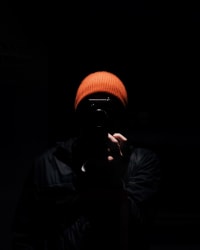
A portrait made at arm’s length — you don’t get this close without asking. Photo: David Lund (@davidlund_photography)
It's 6:40am on Hàng Bè Street, and the woman who sells bún riêu has been awake since three. Her face catches the first hard light cutting between the old shop-houses — a face built from decades of early mornings, a face I desperately want to photograph. She hasn't looked at me once. I've been standing fifteen feet away pretending to check my phone for four minutes, and both of us know exactly what's happening.
Read Yourself First
Every photography guide eventually gets to the subject's body language — are they relaxed, do they seem open, have they clocked you. What gets far less attention, particularly if you're working Vietnam's streets for the first time, is what your own body has been broadcasting since you stepped off the bus. Vietnamese street culture is not hostile to cameras. But it reads energy fast. Walk in tense, apologetic, or furtive and you've already communicated that you believe you're doing something wrong. The street calibrates to that signal quickly.
In Hanoi's Old Quarter or Saigon's District 1 markets, move with purpose but without urgency. Occupy the space without claiming it. Match the pace of the street, which in Vietnam is rarely as fast as your anxiety makes it feel. Move at the rhythm of a market in full swing — the xe ôm drivers idling at corners, the women with shoulder yokes carrying fruit — and your presence reads as part of the scene rather than a disruption of it.
Eye contact is a choice, not a rule. Some photographers find a brief nod before raising the camera disarms the moment before it becomes one. Others shoot first and hold the gaze after, turning the screen to show the frame. Both work. What consistently fails is the look-away immediately after firing. It reads as guilty. If you made the photograph, own it.
The First Five Are the Hardest
The advice to shoot a lot gets misread as permission to spray and pray. It means something more specific: approaching strangers for portraits is a perishable skill, one that degrades without regular use. Shoot weekly rather than in occasional bursts and the approach becomes automatic. The internal debate about whether to walk over stops. You're reading light and moving, not narrating your own hesitation to yourself.
By the fifteenth, you stop thinking about yourself. Vietnam's readiness — the laughter, the genuine curiosity about who's pointing a camera and why — makes the learning curve more forgiving than most places. People want to know what you're doing. Let them ask.
The first five approaches in any session are the hardest. Do them early, get through them, and the rest of the morning opens up.
Use this practically. If you're short on time — an afternoon layover before moving south — force the first five approaches in the opening twenty minutes. Get through the awkward reps while the light is still good and the markets are still at full volume.

The portrait that follows a conversation looks like this. Photo: Pete Walls (@pjwphoto)
Compose Before You Walk In
The approach to a stranger is also the approach to a frame. Decide on the image before you make contact. They've seen the background — the peeling yellow plaster wall, the hanging dried fish, the slant of morning light across a temple doorway — and they're walking toward the picture, not toward the person. The person completes what's already there.
This shift changes the dynamic visibly. When you're reading the environment rather than studying the subject with nervous focus, people feel the difference. You're not asking permission to exist in the space; you already belong to it.
In tight wet markets — Bến Thành's interior in Saigon, or the narrow lanes through Đồng Xuân in Hanoi — work out your frame from the hip before committing to raising the camera. A quick practice frame of the empty background tells you exactly where your feet need to be. When the subject steps into it, you're already there.
Stop Down More Than Feels Natural
Wide-open portraiture flatters, but it also isolates. In Vietnam, where the context is often as meaningful as the face — the cluttered altar behind a xe ôm driver, the corrugated wall of a phở stall, the tangle of live electrical wires between buildings on any given city block — stopping down pulls that meaning into the frame.
f/4 to f/5.6 at close range gives you a subject in clear focus with enough environmental detail to place the viewer somewhere specific. For photographers shooting in Hanoi or working Saigon's streets, the instinct toward maximum bokeh works against the storytelling. The woman selling bánh mì against a backdrop of tangled wires and peeling colonial plaster — the wires are part of the image. Don't dissolve them for a cleaner portrait.
Environmental portrait work in Vietnam's markets often calls for f/4–f/5.6 rather than f/1.8. The surrounding detail — stacked produce, hanging meats, low-slung awnings — provides the cultural specificity that makes the portrait mean something beyond a well-lit face. When in doubt, stop down one stop from what feels natural and see what it gives back.
Have a Settings Floor
Keep a settings floor you can return to in seconds. (Our gear guide covers the specific bodies and lenses that hold up across Vietnam's shooting conditions.) The light here changes in twenty steps — from the blue-grey shadow of a covered market to full tropical sun on the street outside. You can't be scrolling menus when the moment materialises in front of you.
In direct sun: 1/1000s, f/8, ISO 200. In covered markets or shaded lanes, the same aperture calls for ISO 800–1600. Getting comfortable with grain is non-negotiable for anyone spending serious time here. Vietnam's most interesting portrait light lives in the shadows under awnings and beneath the corrugated roofing of wet markets, not in the flat glare of midday open streets.
For autofocus: zone or single-point over face-detect for deliberate portrait work. Face detection has gotten impressive, but it pulls eagerly toward the nearest face — a problem when you want the subject placed off-centre, which is common in environmental portrait work where the background is doing half the storytelling.

Vietnam hands you colour — the blue chair is practically a national institution. Photo: Pete Walls (@pjwphoto)
Colour in Context
Vietnam's light shifts sharply by city, season, and time of day. Hanoi's winter mornings — November through February — run cool and flat. Overcast skies produce a blue-grey cast that auto white balance tends to overcorrect toward artificial warmth. Setting daylight WB at 5500K gives a reliable starting point you can refine in post. Saigon's dry season (November through April) produces cleaner, warmer light with real punch at golden hour; it flatters skin tones in a way the rainy season simply doesn't.
Shooting RAW removes most of this as an in-camera concern, but understanding the native colour temperature of the light you're working in changes how you read a scene before raising the camera. The golden cast over Hội An at dusk, the cool blue wash of Hanoi in January at 6am — these aren't casts to neutralise in Lightroom. They're part of what makes an image feel located in a specific time and place rather than anywhere tropical.
Track Light, Not Subjects
Track the light. The subjects walk into it. The strongest portrait sessions here often spend an hour or more on a single block, watching how the sun moves across it. By the time you've identified a doorway where morning light will create a single hard slash for eight minutes at 7:15am, you're no longer approaching strangers hoping something happens. You're positioned, and you're seeing who steps into what you've already found.
Places worth knowing: the Bà Chiểu market area in Saigon at 6am, when produce sellers are at full volume under corrugated awnings and the eastern light hasn't yet gone harsh. The alleys behind Hoàn Kiếm Lake in Hanoi on a clear January morning, where old French-period shop-houses throw deep diagonal shadows across lanes barely wide enough for a motorbike. The fish market in Đà Nẵng before the stalls begin packing at 8am, when the catch is still live and the sellers haven't yet tired of the morning. These aren't guidebook recommendations. They're spots worth going back to, because the light does something there that rewards showing up before most travellers are awake.
If you want to see how other photographers are reading Vietnam's light before your next trip, the archive is worth spending an afternoon with.

Most people say yes. Many are delighted you asked. Photo: Pete Walls (@pjwphoto)
What Happens Next
The moment after taking someone's portrait matters more than most guides acknowledge. What you do in the next thirty seconds determines whether you leave with a connection or a transaction — and whether you'll be welcome on the same street the following morning.
Showing the image works almost universally in Vietnam. Turn the camera screen toward the subject and watch what happens. You get real expressions: laughter, genuine surprise, sometimes pride, often a wave over a shoulder to bring a friend or neighbour over to look. You also usually get the second photograph, which is almost always better than the first — the guard is down, something real has passed between you, and the subject is no longer performing for the camera.
If someone signals discomfort — pulling back, a hand raised, an uncertain expression — acknowledge it and move on without drama. A nod and a step back. Don't minimise or over-apologise. The photographer who handles rejection without anxiety is the one who keeps working in the same space, on the same street, in the same market week after week. (If you're uncertain about what's permitted where, Vietnam's photography laws and customs guide is worth reading before your first session.)
Occasionally: the person who waved you off at 6:45 is the same one who waves you over at 7:20, having watched you work the street with patience for the intervening half-hour. Not pressing is itself a form of approach. It tells people something about how you see.
- Learn a handful of Vietnamese phrases — "Tôi chụp ảnh được không?" (May I take your photo?) goes a long way even when your tones are imperfect
- Carry a small card with your name and Instagram handle — some subjects genuinely want to find the image later
- Scout your location before the light arrives — morning markets in Vietnam peak between 5:30 and 7:30am
- Know the difference between public and private space — market stalls are public; temple interiors and private courtyards call for a direct ask
- If you shoot film, bring a print from your last session — showing work you've already made here opens conversations nothing else will
If your work has been made on Vietnam's streets — a week in the Old Quarter, a single morning in Hội An, a lucky afternoon in Đà Nẵng — we'd like to see it.
Vietnam Streets is a curated community documenting Vietnamese street life. Submit your work — selected photographs join the 840+ already published here from 170+ photographers.
Submit Your Work →Frequently asked questions
How do you get comfortable approaching strangers?
Force the first five approaches in the opening twenty minutes — the first five are the hardest, and getting them behind you resets your nerves for the rest of the day. Move with purpose but without urgency, and match the pace of the street.
What aperture works for candid street portraits?
At close range, f/4 to f/5.6 gives you a subject in clear focus with enough environmental detail to place the viewer somewhere specific. In tight markets, work the frame out from the hip before you commit to raising the camera.
What should you do right after taking someone’s photo?
Don't look away — the look-away immediately after firing is what consistently fails. A brief nod before you raise the camera, or holding the gaze afterward and turning the screen to show them the frame, both work far better.
One photographer an issue. Free, and no spam.
No spam. Unsubscribe at any time.