Field Notes
Documentary Photography in Vietnam: The Work Starts on the Second Visit
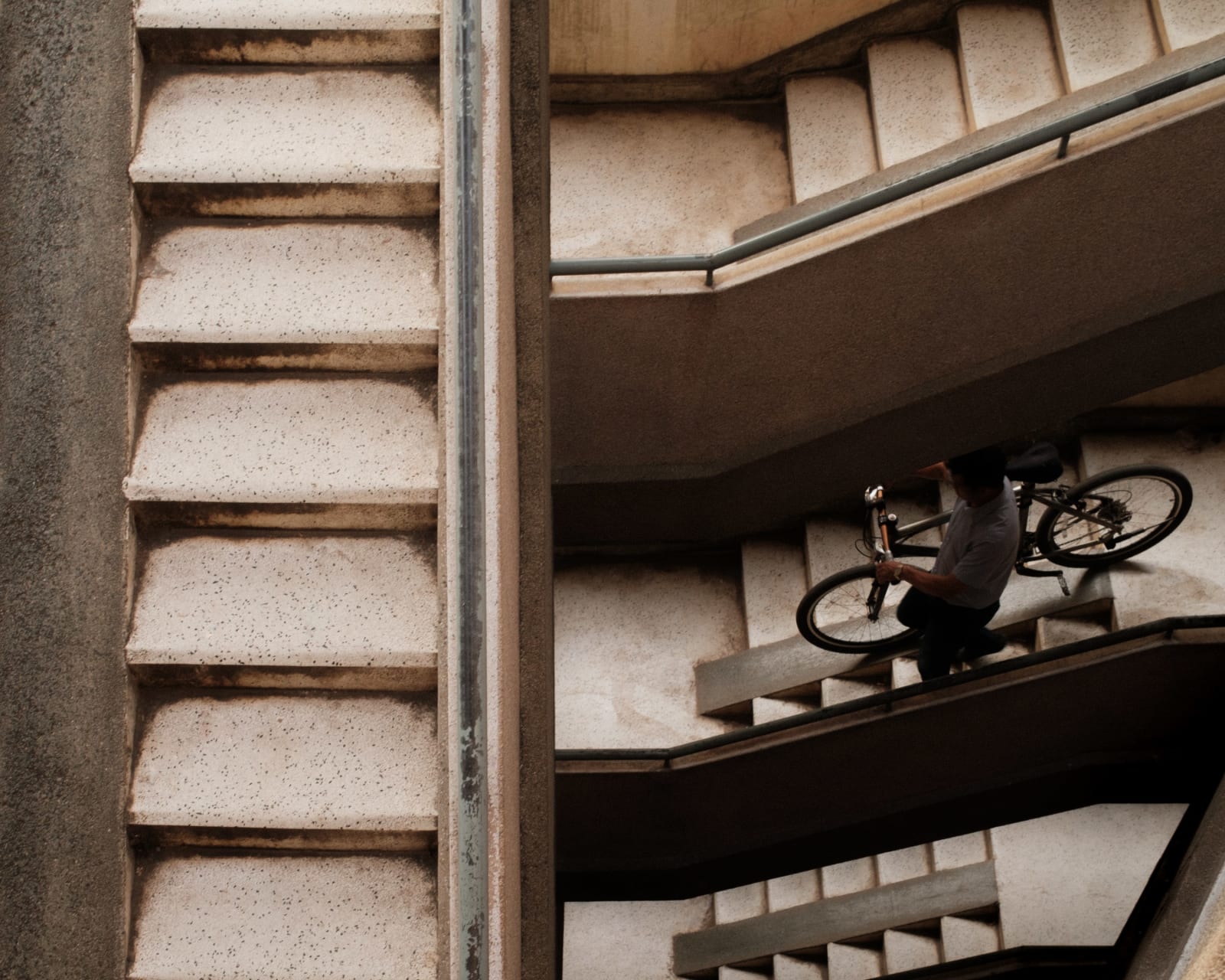
A bicycle carried down an apartment stairwell — the kind of ordinary errand a long project is actually built from. Photo by Jack Ross
A photograph of somewhere you passed through once and a photograph of somewhere you keep returning to can look identical on the day they are made. The difference only shows up years later, when one turns out to be evidence and the other is a souvenir. Documentary photography in Vietnam is mostly a decision about going back.
Documentary or travel — the difference is the return trip
Nothing in the gear separates the two. Both can come off the same card, from the same doorway, made with the same 35mm lens. What separates them is whether you go back.
Travel photography is a first impression, and first impressions of Vietnam are good ones. The trouble is that a first impression is finished the moment it is made. No second frame changes what the first one meant.
Documentary work is what survives the tenth visit. By then the doorway belongs to a man who has been beating aluminium sheet since 1994, and the woman who sold dragonfruit on that corner has stopped coming because the wholesale trade moved out to Bình Ðiền. You are photographing a change, and change is the thing a still photograph is uniquely good at holding.
The subject is usually a change, not a place
Photographers arriving with a project in mind almost always name a place. The Old Quarter. The Mekong. Chợ Lớn. A place has no beginning and no end, so the work has nothing to organise itself around and quietly becomes an album.
Name something in motion instead. Alexandre Garel's work on District 8's canal-side housing, which we published in Streets & Stories, works as documentary because the neighbourhood is being cleared — every frame is dated by definition. The floating market at Cái Răng has been thinning for a decade as bridges and trucking absorbed the trade the river used to carry; count the boats each year and you have a project with a spine.
None of that needs a press pass. It needs noticing a direction of travel and deciding to keep score.
Time is the whole method
The uncomfortable part is that the method is mostly returning. Not technique, not a lens, not a workshop. Returning, on a schedule, to a subject that does not know it is one.
Vietnam supplies the intervals. Hanoi's year has four legible states, from the flat grey of January to the clear October light photographers plan around; Saigon barely shifts, so the variable there is the weather front rather than the season. Timings for both are in the guide to shooting in Hanoi and the guide to shooting in Saigon.
The northern highlands hand you a calendar whether you want one or not. Đồng Văn's market runs Sunday, Mèo Vạc's cattle market the same morning, and rotating markets like Lũng Phìn move on a six-day cycle. If your subject is a highland economy, the return interval has been chosen for you.
On the second visit, remake one frame from exactly where you stood the first time — same position, same focal length, same hour. It will feel like a wasted exposure, and for two years it usually is. Then a shopfront changes hands, and you hold the only pair of pictures that proves it.
What a documentary frame owes the person in it
Three things, in order: consent, context, and a refusal to flatter the picture at the subject's expense.
Consent here is more often gestural than verbal, and it is rarely a problem for anyone working slowly. Raise the camera slightly, catch the eye, wait a beat; a hand turned palm-down is a no, and it is final. If you have any Vietnamese at all, cho con chụp một tấm được không ạ does more work than fluency would. For anyone whose face carries the project, get their name spelled with its diacritics and send the pictures afterwards.
Context is the harder discipline, because it is an editing problem rather than a shooting one. A frame can be true and its caption still lie, and the failure mode is always exoticism: the packaging that calls working people reclusive, or a province untouched, when the woman in the frame sells to a wholesaler in Hanoi twice a month. She is at work on a Sunday. Photograph the work. The ethics of photographing people in Asia goes further into where those lines sit.
Two limits: military installations, border posts and some port infrastructure are genuinely off limits, and if you are working one alley repeatedly, introducing yourself at the ward office turns a suspicion into a permission.
Captions are part of the work
A documentary photograph without a where and a when is a decorative one — the difference between a picture that still means something in 2050 and one somebody eventually captions Vietnam, c. 2020s by guesswork. Record it on the day; nobody reconstructs this from memory six months later.
- Full place name with diacritics — street, ward, district.
- Date and approximate time. The hour is what dates the light.
- The subject's name as they spell it, and how they want crediting.
- What was happening, and what is changing here — that becomes the through-line.
Starting your own project in Vietnam
Pick a change you can reach on a repeating schedule. That matters more than how interesting the subject sounds: a thinning trade twenty minutes away beats a spectacular one that costs two flights, because you will go back to the first and you will not go back to the second.
Then shoot the ordinary parts. Strong sequences are almost never built from dramatic frames — they come from the closing-up shot, the delivery, the lunch, the empty room after everyone has gone. Dramatic frames punctuate; ordinary frames carry the weight.
Expect the first year to be reconnaissance. Weekly edits reward the loud picture; annual edits show what you have accumulated. Work with one body and one lens — a 35mm equivalent is the honest default, because Vietnamese alleys rarely let you stand back.
And find somewhere to show the work while it is unfinished; projects die in private. The Vietnam Streets community has published a few hundred photographers' work, and Streets & Stories gives one photographer a whole issue rather than a slot in a grid.
What is documentary photography?
Sustained, returning photography of a real situation, made to record it rather than to illustrate an idea about it. The defining feature is duration: a single visit produces travel photography however good the frames are.
How is it different from photojournalism?
Photojournalism is tied to an event and a deadline and answers to an editor. Documentary work sets its own clock and is usually self-funded — which is what lets it continue after the story stops being current.
Do I need permission to photograph people in Vietnam?
Not legally, in a public place, in most ordinary situations — but the question worth asking is whether you have it, not whether you need it. Eye contact and a nod is the working standard, and a refusal is final. It becomes a requirement in homes and workplaces, at funerals, and near military or border infrastructure, where photography is prohibited outright.
How long should a documentary project take?
Longer than you plan for. A useful minimum is a full year, so you have seen the subject through every season; the projects that hold up tend to run three to five.
Vietnam Streets is a curated community documenting Vietnamese street life. Submit your work — selected photographs join the 950+ already published here from 180+ photographers.
Submit your work
One photographer an issue. Free, and no spam.
No spam. Unsubscribe at any time.