Field Notes
Film Photography's Quiet Revival in Vietnam
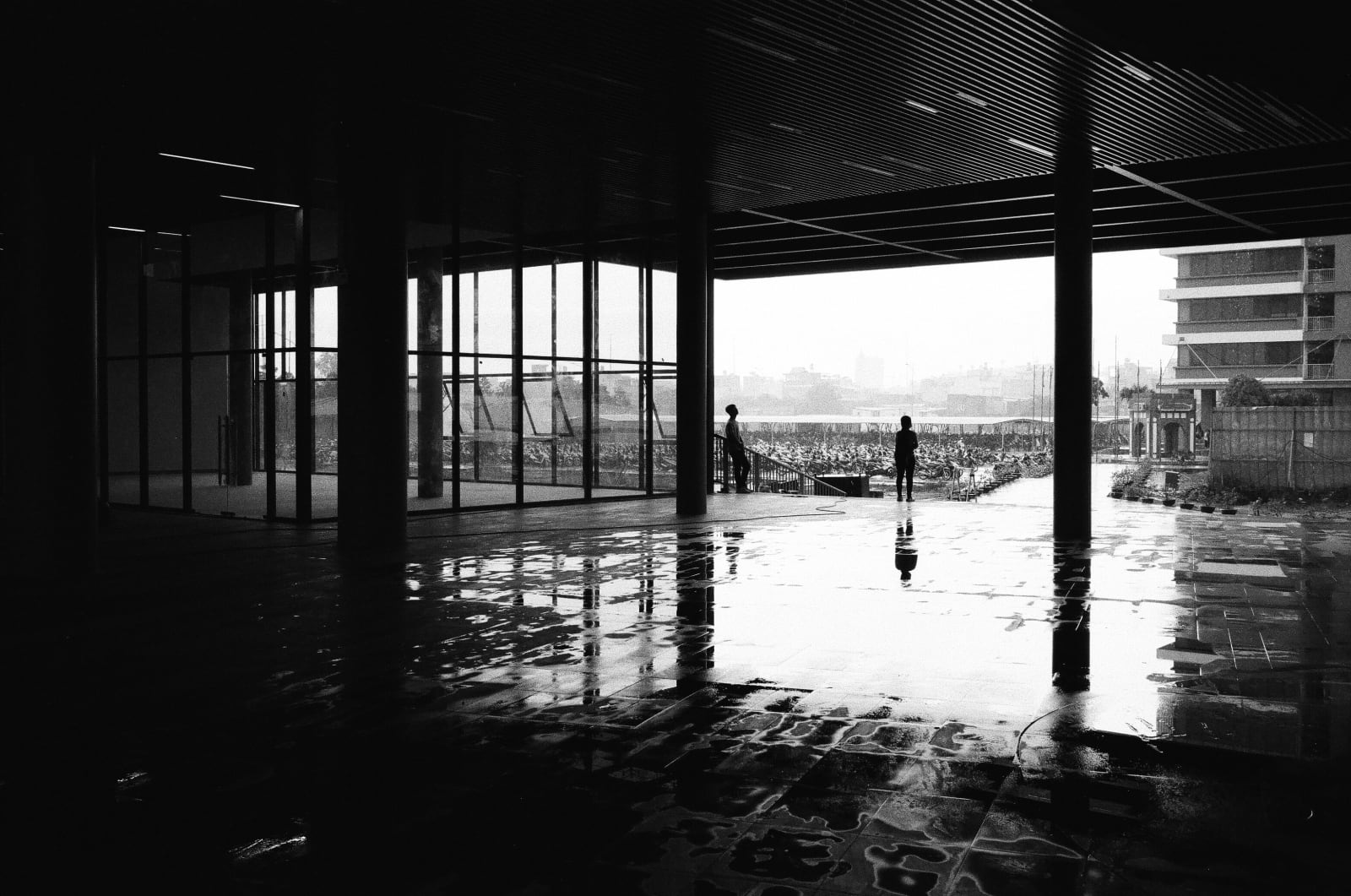
The frame you don’t get to check. Photo by Jack Ross (@jackjross)
At the electronics stalls off Nhật Tảo, the repair bench is a sheet of plywood the size of a placemat, lit by a bare LED strip and a loupe screwed into a paint tin. A man in his sixties holds a Nikon FM2 to his ear, fires it at 1/1000, then at 1/500, listening the way a mechanic listens to an engine, and pronounces the second curtain lazy — come back Thursday. Two stalls down, a young woman born a decade after the last Kodak minilab in the neighbourhood shut its doors is buying her third roll of Gold 200 this month.
What the minilabs left behind
To understand the film photography Vietnam analogue resurgence, you have to start with how far film once reached into ordinary Vietnamese life — and how thin the margin was that made it possible. In the late eighties, a camera was capital. Photographers worked Hoàn Kiếm Lake and the lawns in front of Reunification Palace the way a barber works a corner: a Zenit or a Praktica that came in through Eastern Bloc trade, a Canon AE-1 that came home in a returning worker's luggage, a roll stretched to thirty-nine frames, families in their good clothes, a receipt, prints in three days.
The trade had its own vocabulary and its own geography. Hiệu ảnh — the neighbourhood photo studio — meant a painted backdrop, a fan, a hot light, and a technician who knew exactly what the local water temperature did to development times. After the mid-nineties opening, Fuji and Kodak minilabs bloomed on every commercial street in Hanoi and Saigon, and the whole pipeline compressed from three days to one hour. Tết portraits. Graduation. The wedding boom. A minilab operator in District 1 could put children through school on a machine the size of a chest freezer.
That is the part the nostalgia market tends to flatten into aesthetic. It was not an aesthetic. It was thousands of people with a trade — printers, colour timers, retouchers who worked with a brush on the negative, shutter men, the guy who only did light seals — distributed through every ward of every city, sustained by the fact that photographing your family was a paid transaction with a specialist.
The years the labs went dark
The collapse was fast, and it did not come from Kodak's balance sheet. It came from a $180 digital compact, and then from the camera phone. By 2008 the one-hour lab had no hour to sell. Frontier and Noritsu machines that had cost more than an apartment were sold for the weight of their steel or left to seize in back rooms. The technicians did what technicians do: they went into phone repair, into wedding video, into printing banners. A generation of specific expertise dispersed into adjacent work and mostly did not come back.
What survived, survived by accident. A dry cabinet in a back room in Phú Nhuận. A box of Superia that a shop owner could not bring himself to throw out. Three or four people in each city who kept a tank and a changing bag because they liked it. If you shot film in Vietnam between roughly 2009 and 2014, you know the texture of that period — you mailed your rolls to Bangkok, or you souped them yourself in a bathroom at 30°C and fought the base fog.
The labs that reopened are not the labs that closed. What came back is a new industry wearing the old one's clothes.
The resurgence is a new industry, not a revival
From about 2016 the demand curve turned, and it turned from the youngest end of the market. Chụp film became a thing you did on purpose. Graduation albums — ảnh kỷ yếu — went analogue by choice. Wedding photographers started offering a film package at a premium. Labs opened in District 3, in Bình Thạnh, in the lanes off Nguyễn Hữu Huân in Hanoi, most of them run by people in their twenties and thirties who bought a refurbished Noritsu, learned it from forums and from one surviving old-timer, and built the business on Instagram rather than on foot traffic.
The economics inverted. Film went from the cheap way to make a picture to the expensive way. A roll of Kodak Gold that cost pocket change in 2005 now runs multiples of that, and the interesting consequence is a genuinely local supply chain: motion picture stock — Vision3 250D and 500T, bought in long rolls, remjet removed, hand-spooled into reusable cassettes — is now a normal thing to buy from a Vietnamese seller and a normal thing for a Vietnamese lab to run in ECN-2. So is respooled aerial and surveillance black-and-white. It is improvisational, occasionally inconsistent, and in keeping with a country that has always been good at keeping machines alive past their designed lifespan.
The used-camera market reorganised around the same demand. The Contax T2 and the Olympus mju-II priced themselves into absurdity, as they did everywhere. But the practical middle of the market held: Nikon FM2 and FE2 bodies, Canon AE-1 and A-1, Olympus OM-1, Pentax K1000, Yashica Electro 35 rangefinders, Canonet QL17s, Nikon L35AF compacts that do everything a mju-II does for a fifth of the money. Go to the electronics stalls off Nhật Tảo in District 10, or the small shops behind Hàng Bài in Hanoi, and the inventory is the sane end of the list — because the people who sell there also have to service what they sell.
Before you buy a body in Vietnam, hold the lens up to the LED strip and look through it at an angle for the faint white filigree of fungus. Humidity here is the single largest destroyer of glass, and a fungused 50mm looks perfectly fine pointed at a wall. Then fire every shutter speed twice, listening — 1s down to 1/1000 — and check the film door foam with a fingernail. A body with clean glass and a lazy curtain is worth buying. Clean curtains and hazed glass is not.
Ask which machine scanned your film
Here is the craft consequence that most photographers arriving in Vietnam with a film camera underestimate: for the next while, your lab is a bigger variable in your look than your film stock is. Almost nobody is optically printing. What you get back is a scan, and a scan is an interpretation.
Learn the two machines. A Fuji Frontier SP-3000 tends toward cooler, softer, slightly cyan-leaning renderings with gentle highlight rolloff. A Noritsu — the HS-1800 is the one most Vietnamese labs advertise — comes back sharper, warmer, more contrast in the midtones, and more aggressive in the reds. Neither is correct. But if you shoot a roll at a Frontier lab in Bình Thạnh and the next at a Noritsu lab in District 3, you have introduced a variable that will make you blame your metering for something that happened in software.
So: pick one lab and stay with it long enough to learn what it does. Ask whether the operator colour-corrects frame by frame or applies one profile per roll — per-frame correction is a kindness on a mixed roll and a curse on a deliberately consistent one. If you are doing your own colour work, ask for flat or minimally corrected scans, and expect to pay for the larger file size. Most labs here will do it and are pleased to be asked, because it means you know what they do for a living.
Metering for Vietnamese light
Vietnamese light punishes casual metering, and film has no histogram to argue with you. Colour negative wants light — rate Gold 200 at 100 and Portra 400 at 200 and you will thank yourself. The shadow detail lives in the exposure you gave it and nowhere else.
The two cities behave nothing alike. Hanoi's Old Quarter is a canyon: four-storey shophouses, tarpaulin and tree cover, a shaded street with a hard slot of sun down the middle. Sunny-16 will lie to you by two full stops depending on which side of Hàng Bồ you are standing on, and an incident reading at your subject's position is worth more than any averaged frame reading. Late February and March bring nồm — the damp southern wind, condensation on every cool surface, a flat pearl-grey sky. That light is a gift for black and white with contrast built in development, and thin misery for colour. October and November are the clean months: dry, angled, honest. If you want the specifics of the routes and the hours, we have them collected in the guide on shooting in Hanoi.
Saigon is the opposite problem — a wide-open, high-sun city where between roughly 11am and 2pm in the dry season the light comes straight down and flattens faces into two dots and a line. Work the edges. The forty minutes after five, when the sun drops low enough to run west down Lê Lợi and Nguyễn Huệ and the whole street turns into a softbox, is worth planning your day around, and it is the single most reliable hour in the country. In the wet season, May to October, the afternoon storm is a schedule, not a risk: shoot the pressure drop, wait it out under an awning with a cà phê sữa đá, then go back out at five when the asphalt is a mirror and every neon sign has a second copy of itself on the ground. More on that rhythm in the notes on shooting in Saigon.
Two hardware realities. First, humidity: a tủ chống ẩm — a dry cabinet held around 45 to 50 percent — is not an optional accessory for a film kit in Vietnam, it is the difference between owning lenses and renting them from the mould. Second, condensation: walk a cold air-conditioned camera into 33°C and 85 percent humidity and you will fog the glass, and if you force the advance you can find the film has gone tacky. Give it ten minutes in the bag to come up to temperature. It is the most boring discipline in tropical photography and the one people skip.
The camera as a social object
The thing nobody tells you about carrying a mechanical camera in Vietnam is that it changes the answer you get. A phone lifted at chest height reads as surveillance. A black FM2 held at your waist reads as an object — a tool, something with a price and a history, something a man at a bia hơi table might have owned in 1994. Older Vietnamese people in particular respond to it, and the response is usually curiosity rather than suspicion.
But film takes away your closing move. You cannot turn the camera around and show someone the frame, and the little ritual of showing the back of the camera is how a great many street portraits get their consent retroactively. So the transaction has to happen in front: a nod, a raised camera, chụp một tấm nhé — one shot, okay? And then, if you mean it, an actual promise. Get the print made at your lab, 4x6, and bring it back to the woman at the bún chả cart. That single act will do more for you than any amount of technique. It is also how you end up with somewhere to sit next time.
The rest is ordinary courtesy with local specifics. In pagodas and temples, no flash and no lens pointed at someone mid-prayer — the incense, the hands, the light through the door are all yours; the face at the altar is not. In markets — Đồng Xuân, Châu Long, Bình Tây, Bà Chiểu — buy something before you start working, because you are in someone's place of business. And keep the camera down around police, military installations, and border areas; a manual camera does not exempt you from that.
Film removes your ability to prove you got the shot. What replaces it is having to actually come back.
What a roll costs you now
Budget honestly. As of this writing, dev-and-scan on a 35mm colour roll in Saigon or Hanoi runs roughly 90,000 to 180,000₫ depending on scan resolution, with black and white usually a little more because fewer labs run it in-house. Stock is the bigger line item — a consumer colour roll is now a meaningful purchase, and Portra is a decision. Kentmere and Fomapan 400 are the honest cheap seats for black and white, and hand-spooled cine stock is the local way to shoot colour volume without going broke.
- Dry cabinet or, at minimum, a sealed box with fresh silica gel — swap the gel weekly in the wet season.
- Buy your stock here rather than flying it in; local labs stock what local labs know how to process.
- Request a hand check at Tân Sơn Nhất and Nội Bài. The newer CT scanners will fog film at any speed, and lead bags do not save you. Say it plainly: phim chụp ảnh, xin kiểm tra tay.
- Pick one lab per city and shoot at least five rolls through it before you judge your own exposures.
- Ask which scanner it runs — Noritsu or Frontier — and write it in the same notebook where you log your rolls.
- Carry a small notebook anyway. Frame numbers, streets, names, and who you owe a print to.
- Overexpose colour negative by a stop and stop worrying about it.
The frame you don't get to check
What links the repair benches and the young labs is not nostalgia. The man testing curtains at Nhật Tảo has no romantic feeling about film at all — it is the trade he learned, and the market came back to him. The young woman buying Gold 200 has no memory of hiệu ảnh, no minilab childhood, nothing to be nostalgic for. What connects them is a machine that still works and a picture that cannot be checked, and that second thing is the whole point. Twenty-four or thirty-six frames, no review, no second chance, and a week between the moment and the evidence. It makes you slower on the street and more honest about what you actually saw.
Film frames tend to do disproportionately well in the Streets & Stories newsletter — the selects run there. More essays like this one live in Field Notes.
Vietnam Streets is a curated community documenting Vietnamese street life. Submit your work — selected photographs join the 950+ already published here from 180+ photographers.
Submit your workFrequently asked questions
Can you still buy and develop film in Vietnam?
Yes — film photography is in the middle of a quiet revival. The minilabs went dark by 2008, but a new industry has grown up in their place: stalls selling fresh rolls, dry cabinets keeping stock, and labs doing serious development and scanning again.
Should you ask how your film is scanned?
Yes — ask which machine scanned your film. The scan decides most of what you'll finally see, so it's the question that separates a serious lab from a merely convenient one.
What does shooting film change about street photography?
The camera becomes a social object — an older man will hold a Nikon FM2 to his ear and diagnose the shutter by sound. And you don't get to check the frame, which changes how you shoot: you commit, and you move on.

One photographer an issue. Free, and no spam.
No spam. Unsubscribe at any time.