Field Notes
Photographing Vietnamese Wet Markets
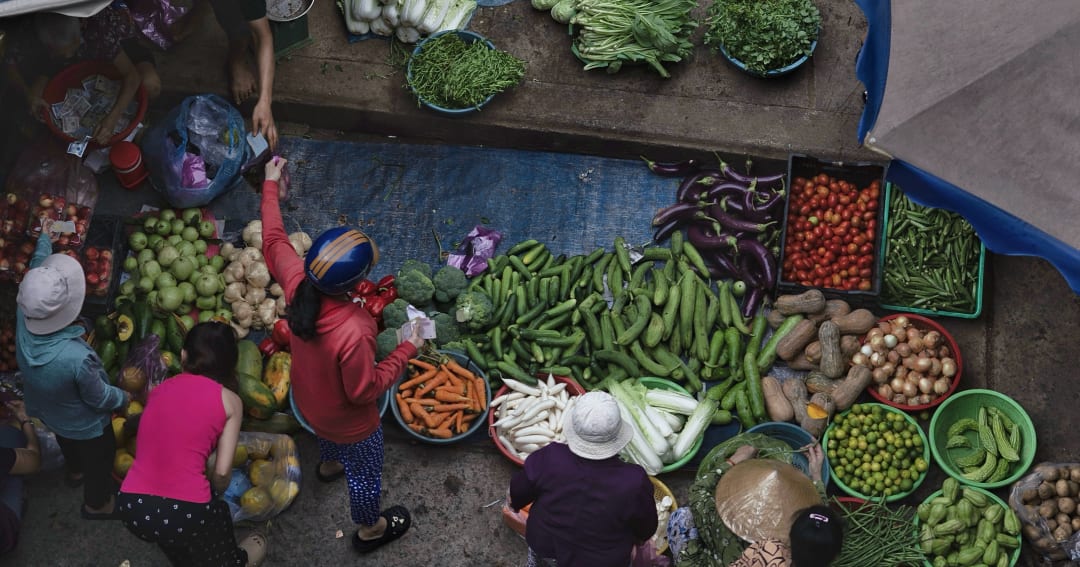
Overhead view of a produce market. Photo: David Lund (@davidlund_photography)
The first thing you smell, before the light finds you, is fish — the clean brine of something caught last night, layered over an older wetness. It's 5:40 in the morning at Chợ Hội An, and the vendors who arrived at four o'clock have already arranged their catch in rows that run the length of the hall: squid laid flat, chromatophores still flickering under fluorescent tubes; pomfret stacked belly-to-back; buckets of mantis shrimp the color of oxidized copper. By the time you raise your camera, you are already inside someone else's workday.
The Light Before the Crowds
The classic advice about wet markets is to arrive early. This is correct, but the reasons go beyond simply "there's more activity." The light at 5:30am inside a covered Vietnamese market is strange and worth studying: skylights and open doorways admit whatever the sky is doing — often a cool, diffused blue — while the interior stalls run fluorescent or sodium vapor tubes that push everything toward green-yellow. Your camera's auto white balance will fight this and lose. Set it manually to 4000–4500K and let the blues from doorways skew warm, or shoot in the tungsten preset and accept that cool natural light will go blue-purple. Either approach produces colors more interesting than any neutral correction would.
The window is narrow. By 7:30am, most covered markets in Hanoi and Saigon are crowded enough that candid work becomes difficult. By 8am, vendors who rose at four are tired of eye contact. If you're shooting Chợ Hội An, subtract thirty minutes from those numbers: the market faces east, and after 6:30am, hard tropical sun enters the seafood hall and kills the atmosphere entirely.
The exception is markets that serve the restaurant trade wholesale. These run from midnight to 4am. Chợ Bình Điền, on the southern edge of Saigon, is the largest wholesale market in the south: its fish hall at 2am looks nothing like any wet market photograph you've seen. Buyers arrive on motorcycles with foam coolers strapped behind. Transactions happen in bulk, fast, without ceremony. This is not a place that caters to curious onlookers, which is exactly why it's worth the 3am alarm.
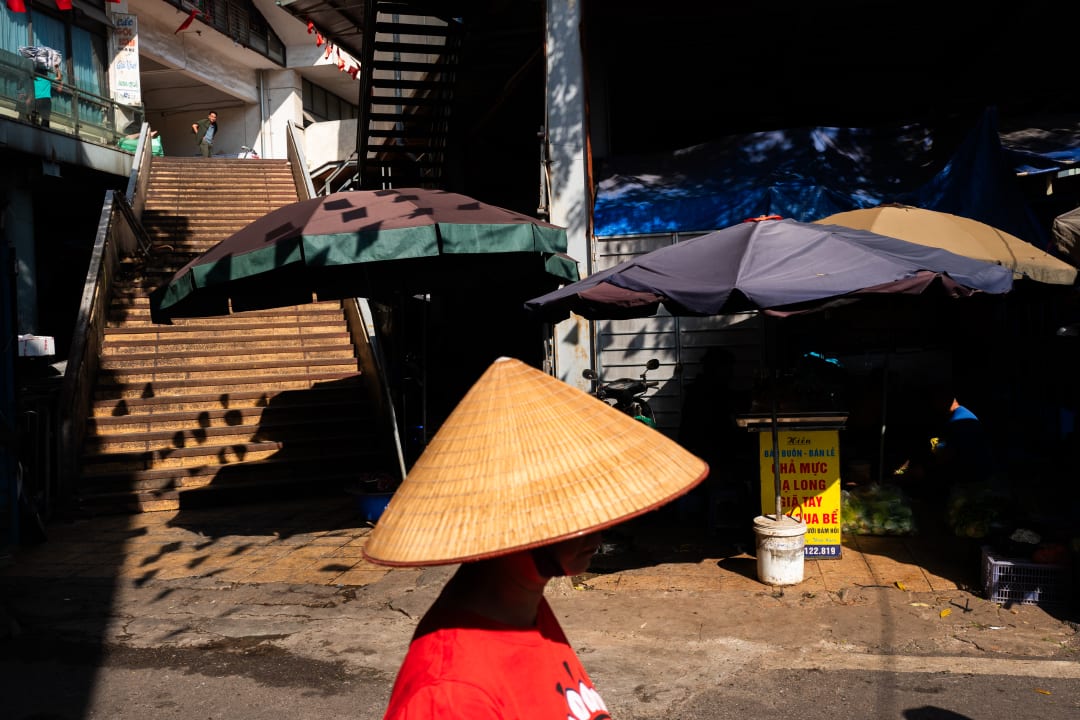
The first hour is the market’s most photographic — and its busiest for the people working it. Photo: Lâm Xuân Tùng (@tungxuanlam_street)
Choosing Your Market
Not all wet markets offer the same photographic return, and the choice matters more than most guides acknowledge.
In Saigon, Bình Tây Market in Chợ Lớn (District 5) is the place most street photographers haven't prioritized — a mistake. It's a wholesale market serving the Chinese-Vietnamese community: sprawling, covered, and genuinely functional at 6am before the day-trippers reach Bến Thành. The clientele are shop owners restocking. The light inside is low and uneven. There are almost no smartphones pointed at products. It photographs the way markets should but rarely do. For context on the surrounding neighborhoods and how to move through Saigon's districts with a camera, the guide to shooting in Saigon covers timing and access street by street.
Bến Thành itself is not what you're after. By 7:30am the tourist economy has colonized the entrance and the vendors near the front have been photographed ten thousand times — they know it. If you do go, the south entrance before 6am, when the produce and flower vendors are still working by their own standards, produces legitimate images. The interior after 8am produces nothing worth the card space.
In Hanoi, Đồng Xuân Market is the reference point: a multi-story structure near the northern edge of the Old Quarter that has operated on roughly this footprint for over 150 years. The ground floor opens before 5am for produce and meat. The upper floors are wholesale textiles with no photographic interest. What makes Đồng Xuân compelling is compression — vendors occupy so little space that the visual relationships between people and goods are tight, which rewards photographers working at 35mm or tighter. The guide to shooting in Hanoi covers the surrounding lanes of the Old Quarter and how they connect to the market's light cycles in the early morning hours.
In Hội An, Chợ Hội An near the Thu Bồn River earns its reputation. The seafood section between 5:30 and 6:30am is the one to work — partly the catch, partly the vendors who have known each other for decades and talk across stalls in ways that produce genuine unguarded moments. After 8am the tourist-adjacent craft section dominates the interior and the market loses its character entirely. Get there early or don't bother.
Da Nang's Chợ Hàn is smaller, less visited by photographers, and more manageable as a result. Its dry-goods and produce section works well for portrait shooting in low natural light, without the Hội An crowds pressing from all sides.
Getting In Without Getting in the Way
The wet market is a workplace. Treat it that way.
Buy something before you shoot anything. This is not a ceremonial gesture — it's a functional one. The act of exchanging money establishes that you are a customer, which is the context within which vendors have the most tolerance for someone lingering. A 10,000 VND bunch of morning glory, a kilo of grapefruit, a bag of dried shrimp — none of it needs to be much. What it buys is a different relationship with the space. You are no longer just a foreigner with a camera. You are, in some small way, participating in the market's purpose.
Body language communicates more than language. Most wet market vendors in Vietnam's major cities have limited English and no interest in negotiating a photo opportunity in a second language at 6am. What communicates is posture: moving slowly, not crowding someone's stall, not shooting at a person from two feet away without eye contact first. Make eye contact, smile, wait a beat. If someone shakes their head or turns away, that's a no — move on without comment. If they keep working, that's often implicit permission. If they look back with curiosity or amusement, follow that thread.
The meat and fish sections require separate consideration. These are also the sections that produce the most powerful images — the visceral reality of where food comes from, the precision of vendors' work, the texture and color that no other photography subject provides in the same way. They're also the sections where some visitors project their own discomfort onto vendors who are doing skilled labor. Approach as you would approach any industrial workplace: with respect for the work, without sentimentality, without framing the activity as spectacle.
The vendor has been arranging fish since 4am. She's not your subject matter — she's a professional doing skilled work. Make that the photograph.
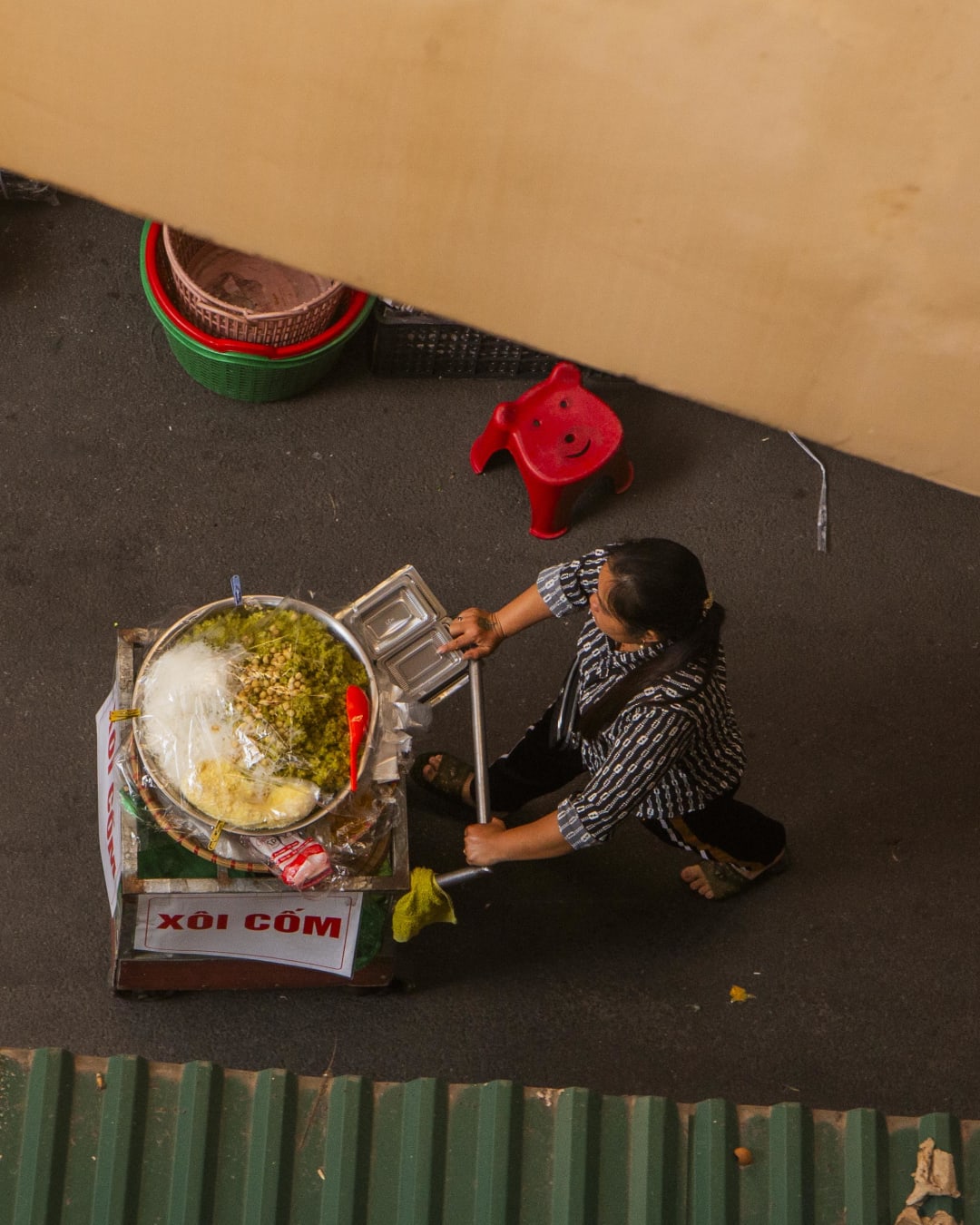
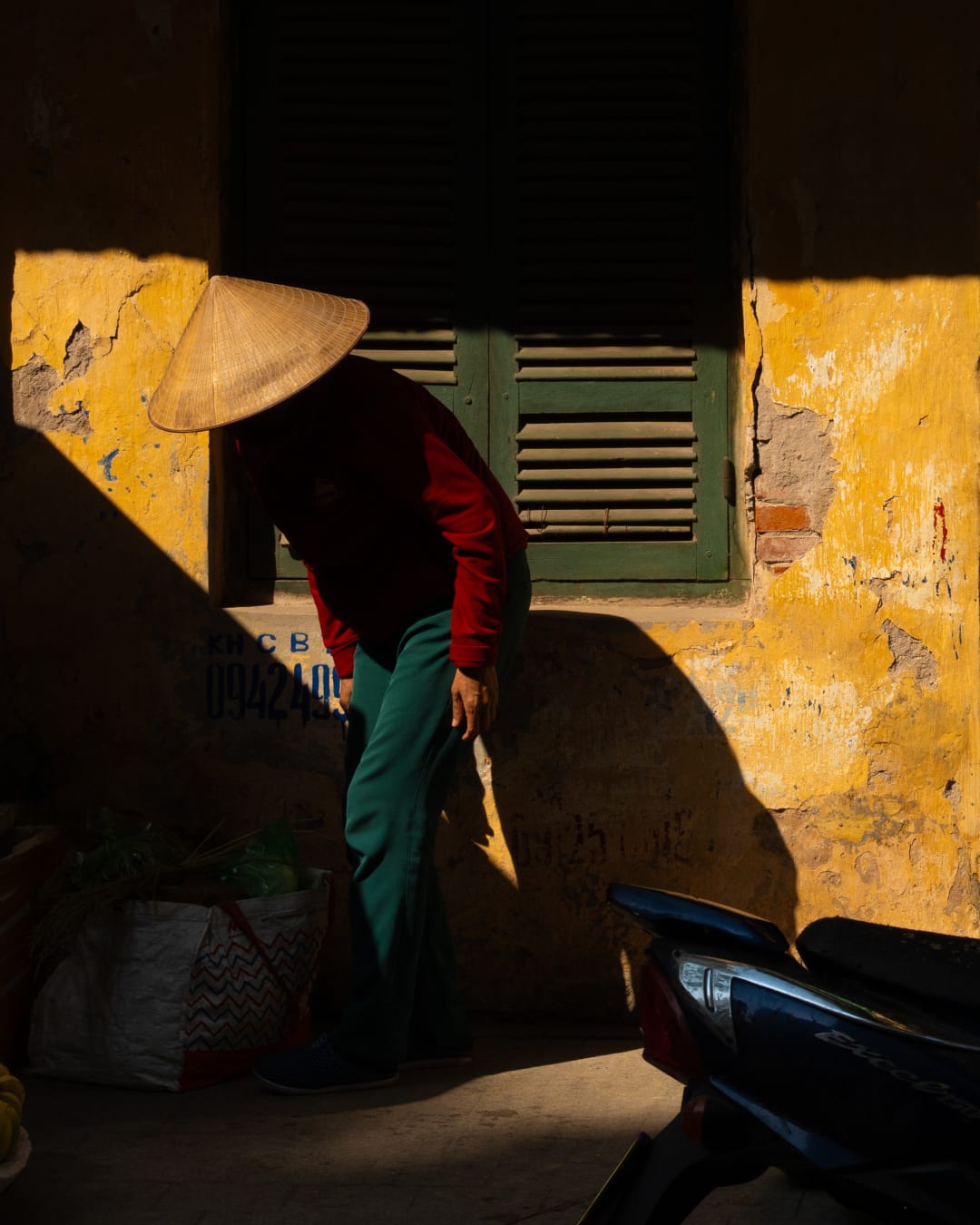
Left: photo Xuan Phuong Le (@xuanphuong.clover). Right: Chợ Châu Long, Hanoi — photo Lâm Xuân Tùng (@tungxuanlam_street).
Gear for the Environment
Wet markets are, literally, wet. Fish water pools on concrete floors. Vendors hose surfaces mid-morning. In the rainy season, condensation from cold seafood cases moves into the warm air and coats every surface. Hardware choices matter here in ways they don't on a dry street corner.
Travel with your smallest capable body. The Fuji X100VI works well in this environment for reasons that compound: the fixed 35mm equivalent forces commitment to a single working distance, the compact profile draws less attention than a mirrorless body with a white-barreled zoom, and Fuji's film simulations — Classic Neg in particular — handle mixed-source lighting better than most RAW correction workflows. If you're on Sony, the ZV-E10 II is less physically imposing than an A7-series body, and people respond to smaller cameras differently. The absence of a prominent grip reads as less professional, which in this context is an advantage.
Primes only. A 35mm and 50mm equivalent cover everything a covered market demands. There's rarely enough physical space to work at anything longer. Zoom lenses are the wrong tool here — not because of image quality, but because adjusting focal length becomes a way of avoiding commitment to a position, which is the wrong instinct in a tight, high-context environment where the image exists between you and the subject rather than at a safe telephoto distance.
Shoot at ISO 3200 without anxiety. Markets before 6am are dim. A minimum shutter speed of 1/200, ISO 3200, and f/2 gives enough latitude to freeze the motion of hands that are always moving while maintaining enough depth to separate a subject from a busy background when you find the right distance.
Leave the camera bag at the guesthouse. One body, one lens, phone, cash — carry only what's on your body. A backpack in a crowded wet market is an obstacle and a target. Vendors moving stacked produce on shoulder poles need the corridor clear. Anything you can't access in a single reach isn't coming out anyway.
Condensation is your biggest hardware risk at wet markets. Moving from an air-conditioned vehicle or guesthouse directly into a humid covered market, leave your camera in your jacket pocket or a sealed bag for five minutes before exposing it to the air. The temperature differential between cold glass and warm humid air is enough to fog a front element in under a minute — and fogged glass in a market environment is not easy to clean.
Reading the Market's Rhythm
Wet markets in Vietnam follow a schedule that's worth understanding before you arrive. The rhythm varies by type — retail versus wholesale — but the retail markets you're most likely to photograph follow a similar pattern across cities.
4:00–5:30am — Setup. Produce arrives from trucks. Fish vendors, who have often been working since midnight at wholesale markets, are already in position and arranging stock. Fewer people, lower noise, and vendors in the middle of creating their displays produce interesting organizational compositions that disappear once trading begins. This is the most intimate phase and the most forgiving for unhurried work.
5:30–7:30am — The primary window. Customers arrive: housewives and restaurant buyers first, then casual shoppers. Energy ratchets up steadily. Light coming through doorways and skylights is most useful during this period. This is the phase to build your session around.
7:30–9:00am — Wind-down. The crowd peaks and then transitions. Regular vendors start winding down as stock depletes. The light is harder and less atmospheric, but the market is physically richer: spilled produce on floors, empty crates stacked at odd angles, a vendor napping behind her stall. These are slower, quieter images.
9:00am onward — Cleaning. Concrete floors get hosed. Plastic tarps come up. The market shows its structural bones. These images rarely appear in editorial contexts, but they photograph like stage sets — vast, drained of purpose, and strangely beautiful in the emptiness.
The Vietnam Streets community regularly features market work from across the country, and the community roll on the site is where it collects.
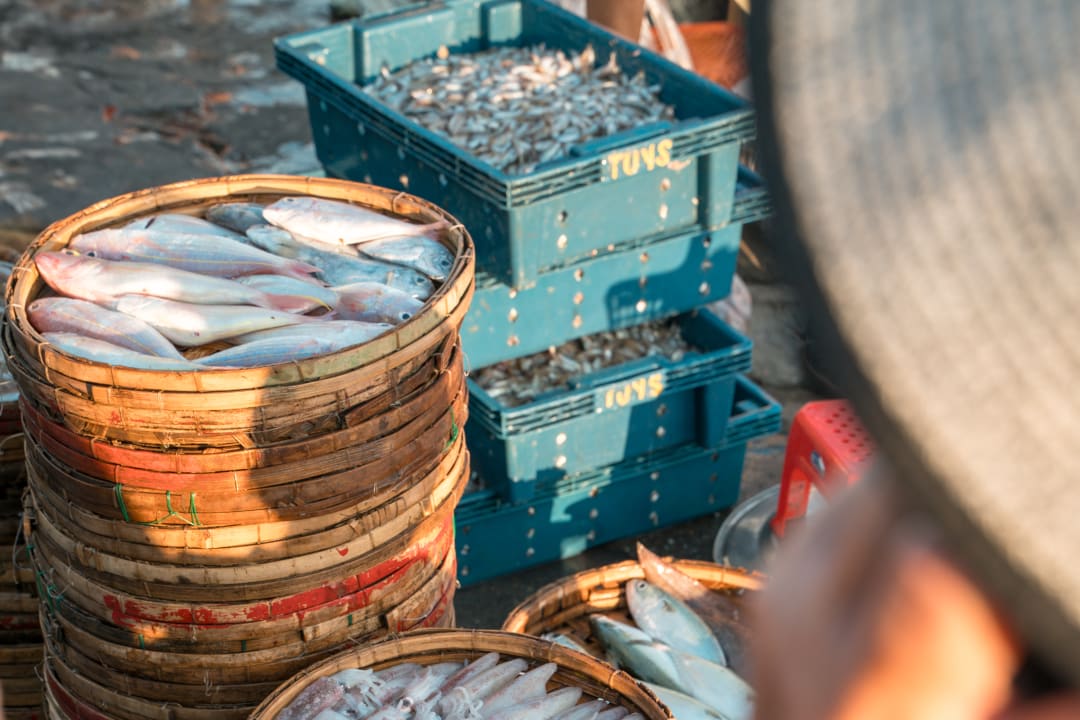
The goods themselves are compositions — look down as often as you look across. Photo: Pete Walls (@pjwphoto)
What the Camera Misses
There is an image that almost everyone makes at Vietnamese wet markets: a wide shot of a stall piled high with abundance, photographed from standing height with the vendor somewhere in the middle distance. The image is accurate and competent and says nothing that hasn't been said ten thousand times before.
The market rewards photographers who look at what the abundance is built from. Not the goods themselves, but the individual transaction beneath them. A vendor's hands at the end of a long morning — not actively working, just resting on the counter with a certain exhaustion. The contrast between weathered skin and the precision of practiced movement. A vendor pulling a plastic shade against morning sun slanting through a doorway. The gap between two stalls where someone is eating breakfast. A scale being read, the buyer watching it with the particular skepticism of long experience. A child doing homework on a shipping crate while her mother sells herbs two meters away.
These are not compositional tricks — they are what the market actually contains, and finding them requires slowing down past the obvious frame and spending time in one position rather than moving through the aisles collecting wide shots.
The central tension of market photography is the relationship between scale and intimacy. A wide shot reads as reportage — it tells viewers what markets look like. A close shot reads as portraiture — it tells viewers something about a specific person. The most interesting market photographs hold both at once: a close subject with a context that suggests the wider world behind them. Getting there means staying put long enough for the market to forget you're there.
Spend time in one position. The market comes to you more honestly than you can move through it.
Seasonal Timing and What Changes
The two weeks before Tết — Vietnamese Lunar New Year, typically late January or early February — transform every wet market in the country. Markets that are normally orderly become chaotic: flower vendors fill the aisles, live fish are sold from sidewalk tanks, the volume of people tripling over a compressed window. This is the window the pictures come from. The access is harder — faster-moving subjects, more obstructions, vendors too busy to acknowledge a camera either way. Arrive an hour earlier than you normally would, and target the five to ten days before Tết rather than the final 48 hours, when navigating a covered market with a camera becomes a physical challenge.
During the wet season — May through October in the south, November through March in the north — covered markets gain additional photographic layers. Rain sounds on corrugated iron roofs. Vendors repositioning stock away from leaking seams. The particular quality of overcast rainy-day light diffusing through skylights into already-mixed artificial illumination, producing a softness that fine weather never achieves. In the south during heavy rain, outdoor vendors compress into covered spaces, temporarily increasing market density in ways that produce interesting spatial photographs.
The dry season in northern Vietnam — March through May — brings a cold, clear quality of light that reads differently from the humid glow of the rainy months. Northern markets in this period feel more austere, the colors less saturated, the contrasts harder. This is not a disadvantage. It's a different register, and the images look like it.

Buy something first. The portrait comes easier after the transaction. Photo: Pete Walls (@pjwphoto)
Editing What You Bring Back
Market photography produces large card volumes and a low keeper rate. Forty minutes inside Bình Tây at 6am might yield three frames worth keeping. This is not a failure of technique — it's what happens when you're working in a high-motion, low-light environment where the variables that make a photograph cohere align rarely and briefly. Expect it.
Sort by moment before you sort by sharpness. A slightly soft frame of someone in a genuine, unrepeatable moment will outlast a technically perfect image of nothing happening. Flag and cull in Lightroom or Capture One before star-rating. Don't let the impulse to correct color temperature drive what you keep — the mixed light of a market morning is part of what the images are, not a defect to be normalized away.
For work you're proud of, submit it to the Vietnam Streets community. The audience understands the context: the 5am alarm, the slippery concrete floor, the moment of eye contact that lasted half a second. The Streets & Stories newsletter regularly features market photography from across the country, and what gets picked is observational rather than touristic — a photograph made from inside the market's logic rather than one taken from a safe tourist distance. That distinction is exactly what the editors are after.
- Research the specific market's opening time — wholesale and retail markets run on very different schedules
- Set white balance manually before entering (4000–4500K as a baseline for fluorescent-dominant interiors)
- Bring small bills for buying something at the first stall you want to photograph
- Leave the camera bag at the guesthouse — carry one body, one prime, phone, and cash only
- Check the Tết calendar: the two weeks before are the most photogenic and the most crowded
- Allow five minutes for lens condensation when moving from air conditioning into a humid covered market
- Plan your exit before the market transitions — the primary shooting window is roughly 90 minutes
Vietnam Streets is a curated community documenting Vietnamese street life. Submit your work — selected photographs join the 840+ already published here from 170+ photographers.
Submit Your Work →Frequently asked questions
What time should you arrive at a Vietnamese wet market?
Before 7:30am. By then most covered markets in Hanoi and Saigon are crowded enough that candid work becomes difficult. The first hour is the market's most photographic — and its busiest for the people working it.
Which Vietnamese markets are best for photography?
In Saigon, Bình Tây in Chợ Lớn (District 5) is a functional wholesale market most street photographers overlook — genuinely working at 6am before the day-trippers reach Bến Thành. Bến Thành itself isn't what you're after unless you shoot the south entrance before 6am.
Is Chợ Hội An different from the others?
Yes — subtract thirty minutes from your usual timing. The market faces east, and after 6:30am hard tropical sun enters the seafood hall and kills the atmosphere entirely.
One photographer an issue. Free, and no spam.
No spam. Unsubscribe at any time.