Field Notes
The Complete Guide to Travel Photography in Vietnam
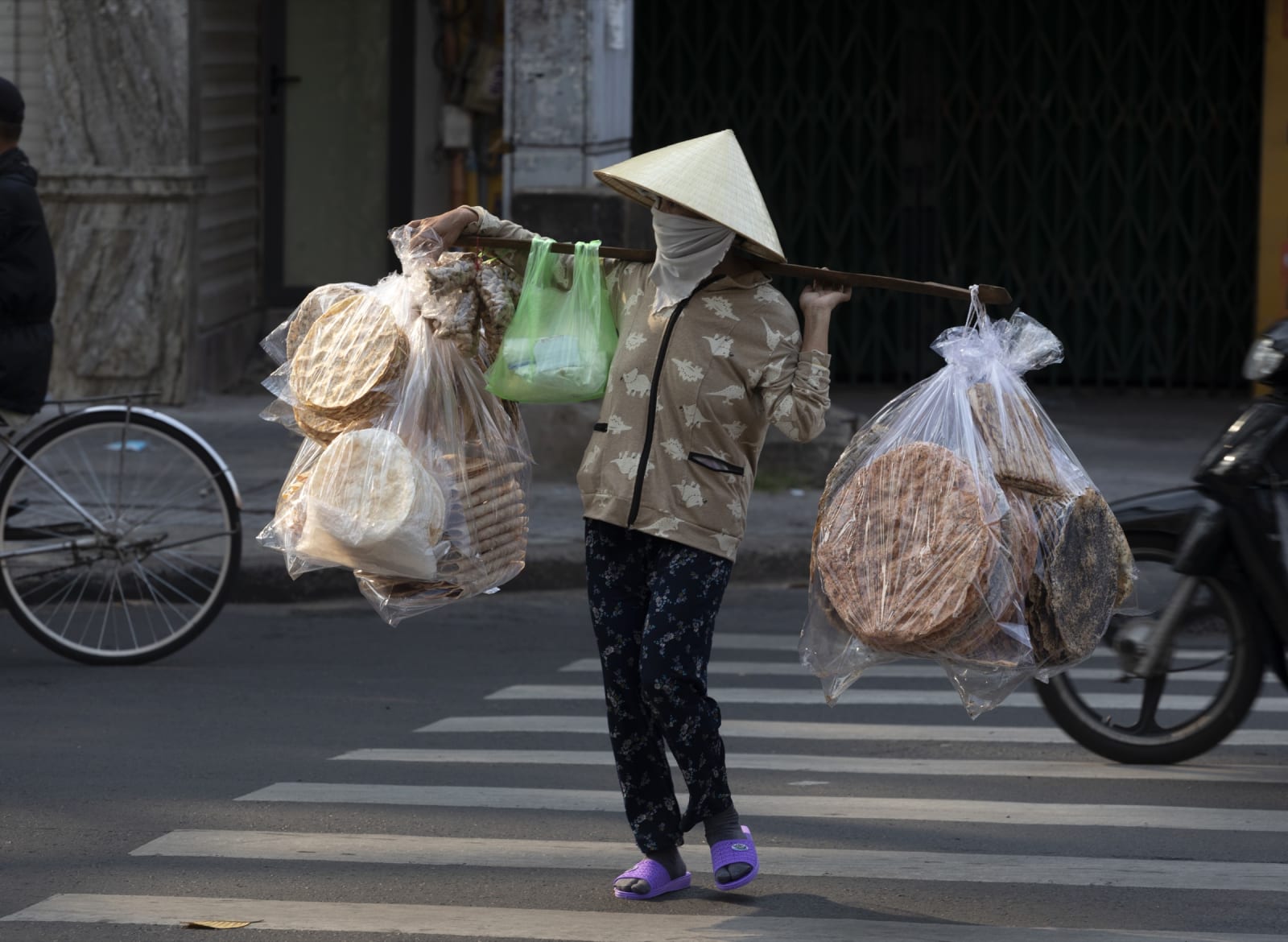
Rice paper vendor mid-crossing. Saigon, April 2022. Canon 5D Mark IV, 159mm f/6.3. Photo by Paul Evan Green (@paul_e_green)
A motorbike courier threads through Chợ Đồng Xuân before the vendors have finished setting out their stalls — the light is horizontal, honeyed, and gone in under a minute. Vietnam operates at a frequency all its own, and after years of shooting here, I'm still learning to keep up. What follows is a working photographer's map of the country: not a tourist checklist, but the framework I wish I'd had when I first landed with a camera and no useful sense of where to stand.
Why Vietnam Rewards the Patient Eye
Vietnam's street life isn't photogenic by accident — it's photogenic because daily life hasn't retreated indoors. Food is cooked on sidewalks, repairs are done in doorways, commerce happens on the curb. The country still runs on the street in a way that most of Southeast Asia has traded away for malls and delivery apps. But that visibility has a cost for photographers: the moments are real, which means they require real presence to earn.
The difference between a grab shot and a genuine documentary image in Vietnam usually comes down to time. Time spent in one spot, time earning trust, time reading the light before it shifts. If you're moving through a neighborhood every few hours, you'll collect the same handful of frames everyone collects. If you sit in the same plastic-stool café for two mornings in a row, the street starts to work around you instead of past you.
Time is the one thing most photographers refuse to give a street.
Where to Point Yourself
Vietnam is long — 1,650 kilometers, two climate zones — and each stretch photographs like a different country. Before you commit an itinerary, a working photographer's map of the ground:
The northern highlands. Sa Pa, Hà Giang, and the market towns of the far north are landscape-and-people country: terraced rice, fog that sits in the valleys until mid-morning, and weekly ethnic-minority markets that are the whole reason to go. Plan around the market day, not the weekend.
The Red River Delta. Hanoi and its orbit. The Old Quarter for dense lane life, the karst rivers of Ninh Bình two hours south, and the limestone seascapes of Hạ Long and Lan Ha bays to the east — three different disciplines within a half-day of each other.
The central coast. Huế's imperial quiet, Hội An's lantern-lit Ancient Town, and Đà Nẵng's beaches and bridges between them. The light here is forgiving — golden, low, and walkable — and the easiest region to work while you're still finding your feet.
The Mekong Delta. Cần Thơ and the maze of canals below it, where water is the street and the floating markets run before dawn. You shoot from a boat here, on the water by 5:30am, or you miss it.
Saigon. The south's engine — District 4's food lanes, the Chinese quarter of Chợ Lớn, the riverside at blue hour. Louder, brighter, and more open to the camera than the north.
Pick one or two of these per trip and stay. Vietnam punishes the checklist and rewards depth — the same lesson the streets teach, applied to the whole country.
Working the Street
Work the Geometry Before the Subject Arrives
Vietnam's streets offer strong compositional structure — particularly in the French-influenced districts of Hanoi and the colonial corridors of Hội An. The key is to find the frame before the subject appears. In Hanoi's Old Quarter, the alley behind Hàng Mắm opens into a small courtyard where morning deliveries pass through; position yourself against the east wall at 6:45am and the backlight does the work for you. For a deep look at specific northern neighborhoods and timing windows, our guide to shooting in Hanoi goes block by block.
In Saigon, the lane markets of Bình Thạnh — particularly the alleys off Đinh Tiên Hoàng — offer layered, compressed frames that make a 50mm feel like a telescope. Lean on foreground elements: hanging laundry, parked xe ôm, stacked bánh mì trays. They add depth and documentary weight that a lone subject rarely provides on its own. The Saigon street photography guide covers the District 1 markets and the riverside corridor in detail.
The Slow Walk
Vietnam rewards the slow walk. Keep your camera at chest height, move at pedestrian pace, and resist the urge to stop and stare. Locals are hyperaware of tourist body language — the camera raised deliberately to the eye, the hesitation mid-stride, the conspicuous framing pause. Instead, practice pre-focusing at a fixed distance (1.5m works well for a 35mm equivalent on APS-C) and making the exposure as you pass. The image comes out of stride, not out of a deliberate stop.
Reciprocity
The single most effective technique I've used across Vietnam — and it sounds obvious until you're in the moment — is showing people their image immediately on the LCD. Not to ask retroactive permission, but because it creates a genuine human exchange. It usually results in the person relaxing naturally for a second frame, which you can use or discard on your own time. This approach matters most in the north, where strangers tend to be considerably more guarded than in the south.
Vietnam-Specific Tips
Light by City
Hanoi's light differs fundamentally from Saigon's. The north sits closer to the Tropic of Cancer and carries a genuine cool season — January temperatures can drop to 12°C, and overcast days diffuse the light beautifully, compressing contrast in a way the south never offers. The Old Quarter shoots well in February fog. Saigon, by contrast, runs tropical and bright year-round: hard shadows, blue skies, a golden hour that lasts perhaps twenty minutes before the light dies completely. For Saigon, shoot before 8am, rest through the midday hours, and return for the afternoon market window in the soft late-day light.
Cultural Calibration
Vietnam has no general law against photographing people in public, but norms vary sharply by region. In the south — especially in Saigon's market districts — most vendors are accustomed to cameras and will either ignore you or perform openly for you. In the north, particularly in smaller towns and highland areas, there's more wariness, especially around ethnic minority communities and active religious spaces. Temple photography is almost always welcomed; photographing worshippers in active prayer, considerably less so. Read the room rather than applying a blanket rule.
Sensitive areas include active military installations, internal government buildings, and facilities with posted restrictions. In Hội An's Ancient Town, there are small photography fees for certain zones — pay them without hesitation. They go to the heritage fund and cost less than a second coffee.
If you're in Hanoi on the eve of Tết, position yourself at Hoàn Kiếm Lake around 10pm. The fireworks draw every family in the city to the lakeside — a mass public moment on a scale the city sees once a year, and almost nobody outside the community photographs it with any real intention. Come with a fast 35mm or 28mm, leave the tripod at the hotel, and work the crowd rather than the sky.
Seasonal Windows
The best photography windows are often counterintuitive. The tail end of typhoon season — late October in the north, November in the south — brings dramatic skies and post-storm light that no planning can replicate. The dry season (November–April in the south, October–March in the north) gives reliable mornings but punishing afternoons. The most difficult window for lane-life street shooting is Tết itself: the streets are quieter than any other time of year, and the holiday celebrations require a different photographic approach than the everyday market and neighborhood work this guide covers.
Getting Around with a Camera
How you move shapes what you shoot. Grab — the ride app — is the default: book a xe ôm motorbike to thread traffic a car can't touch, or a car for gear-heavy days and bad weather. Between cities, the overnight reunification train is slow, photogenic, and kind to your back; cheap domestic flights to Đà Nẵng, Huế, or Cần Thơ buy you time on the ground instead of in transit when the distance is long.
Keep your working kit in a single sling you can swing to your chest on a bike — nothing loose in a backpack pocket, ever. And build in margin. The frames come when you have an unscheduled hour to sit in one spot, not when you're racing a hotel checkout across town.
What to Carry
Vietnam is mercifully gear-agnostic. A Ricoh GR will get you as far as a Leica, possibly further, because inconspicuousness is the practical advantage on these streets. The GR IIIx and the Fujifilm X100VI are the most common cameras I see in the hands of serious shooters here, and for good reason: quiet, compact, and they don't signal "photographer" to every person in a ten-meter radius.
- Fast prime (f/2 or wider) — essential for Saigon's night markets and Hanoi's bia hơi corner after dark
- Compact zoom (28–75mm equivalent) — useful in covered markets where you can't reposition freely
- Polarizing filter — cuts glare off wet streets and the polished tile floors of Vietnamese shophouses
- Rain cover — non-negotiable in any season; a plastic bag and rubber band is sufficient
- Soft local-style sling bag — changes how you're read on the street more than any camera choice
Putting It Together
Vietnam is one of the last countries in Southeast Asia where the street still feels like primary public life rather than scenic backdrop. The photography follows from that reality — when the subject matter is this present and this rich, the work is mostly about showing up consistently, staying long enough, and learning to read the light before it moves on without you.
The Vietnam Streets community includes thousands of photographers documenting this country across every region and season. Browse the Field Notes archive for on-the-ground reports from photographers working specific corridors, and follow the Streets & Stories newsletter for its photographer spotlights.
Vietnam Streets is a curated community documenting Vietnamese street life. Submit your work — selected photographs join the 840+ already published here from 170+ photographers.
Submit Your Work →Frequently asked questions
Where should you go to photograph Vietnam?
Vietnam is 1,650 kilometers across two climate zones, and each stretch photographs like a different country — the northern highlands, the Red River Delta around Hanoi, the central coast, the Mekong Delta, and Saigon. Pick one or two regions per trip and stay; Vietnam punishes the checklist and rewards depth.
How do you get around Vietnam with camera gear?
Grab, the ride app, is the default — a xe ôm motorbike to thread traffic a car can't touch, or a car for gear-heavy days. Between cities the overnight reunification train is slow but kind to your back, and cheap domestic flights buy you time on the ground when the distance is long.
What is the single most useful technique in Vietnam?
Time. The difference between a grab shot and a genuine documentary image usually comes down to how long you stay — sit in the same plastic-stool café for two mornings and the street starts to work around you instead of past you.
One photographer an issue. Free, and no spam.
No spam. Unsubscribe at any time.