Field Notes
A Two-Week Vietnam Photography Itinerary
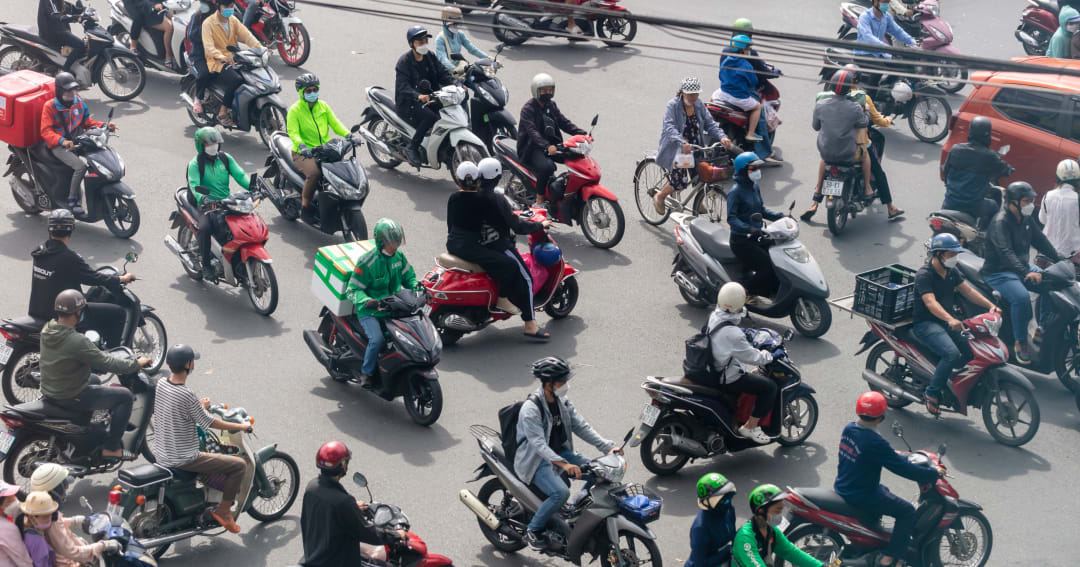
Rush hour, Ho Chi Minh City. Photo: Paul Evan Green (@paul_e_green)
The first alarm goes off at 4:50am. By the time you're on the street in Hanoi's Old Quarter, the wholesale vendors from Đồng Xuân are already pushing handcarts through Hàng Gai — pyramids of lychee and rambutan lit by a single bare bulb, the air still cool enough to see your breath. This is the light Vietnam photographers come back for, and you have fourteen days to find it across three distinct cities, four hundred miles, and a country that shifts character as sharply as its cuisine shifts flavor heading south.
Two Weeks, Four Cities: A Photographer's Route
Most Vietnam photography itineraries are designed for tourists with cameras. This one's built for street photographers — the kind who'd rather spend three mornings in one alley than tick off twelve landmarks. Fourteen days lets you work Hanoi seriously, spend real time in Huế and Hội An, and still arrive in Saigon with enough days left to understand its rhythms before you fly out.
The route runs north to south. Fly into Hanoi, spend four days, then transit through the Central Coast before finishing in Ho Chi Minh City. You'll move through Vietnam's three distinct photographic personalities: the dense layered history of the north, the imperial formality and elaborate food culture of the centre, and the kinetic commercial energy of the south. Each city rewards a different approach, a different pace, and a different lens.
Before you travel, browse the Vietnam Streets community archive — hundreds of photographs from the streets you're about to walk, which will sharpen your eye for what's specific to each city versus what's already been seen a thousand times.
Choosing Your Weeks: Seasonal Light
Vietnam's geography creates three distinct weather systems in the same country. Getting your months wrong doesn't ruin a trip, but it determines what you'll find when you get there.
November through February is the clearest window in the north. Hanoi sits in a subtropical zone: cooler temperatures in December and January (12–18°C), occasional mist that hangs in the Old Quarter alleys until 9am, and the flat even quality of winter light that suits portrait work. Spring — March and April — brings hazy warmth and the country's best festival cycle. If your timing lands in the week before Tết (Lunar New Year, usually late January or February), you'll find flower markets, family buying frenzies, and incense smoke layered through every street in the city.
The Central Coast — Huế, Da Nang, Hội An — runs counter to both north and south. Its rainy season falls October through December, meaning the south's dry season coincides poorly with clear Central skies. Budget for at least one rain day in Hội An if you're traveling in December. Bring a waterproof bag cover; don't rely on prayers.
The south (Ho Chi Minh City) has two seasons: dry November–April and wet May–October. The wet season is useful for photographers — monsoon light creates reflections on flooded streets, and the rain tends to fall in short, intense afternoon bursts that clear before sunset, leaving the air washed and the light diffuse.
Tết is the busiest week in the Vietnamese year and one of the hardest to work. The week before sees flower markets, family preparations, and incense smoke layered through every neighborhood in the country. The week after is quieter than any other time of year — empty streets, temples busy with post-festival rituals, almost no tourists. If you want surge and energy, arrive before; if you want space and intimate access, arrive after. First-time visitors often underestimate how difficult the Tết peak is to navigate with a camera.
Getting Around With Your Gear
Vietnam's domestic airline network — Vietnam Airlines, VietJet, Bamboo Airways — makes the north-south transit efficient. The Hanoi–Da Nang or Hanoi–Huế flight runs around ninety minutes and is inexpensive booked two to three weeks out. The overnight train from Hanoi to Đà Nẵng (12–14 hours, SE1 or SE3 service) is an alternative worth considering: you lose a night's shooting but arrive at a station ready to work at dawn rather than burning a transit afternoon after a morning flight.
Within cities, Grab Moto is how most photographers move once they've found their rhythm. Slow enough to see the street, maneuverable enough to reach alleys. Hanoi's Old Quarter is walkable — on foot before 6am you can cover eight streets in two hours without flagging a ride.
Pack light. Vietnam is humid year-round, and every extra kilogram of gear is felt after three hours of walking in thirty-degree heat. A mirrorless body with two fast primes — 28mm and 50mm equivalent — covers ninety percent of Vietnamese street work. Bring dessicant packets for your bag; fungus is a real risk if wet equipment goes into a closed case overnight.

Hanoi rewards the walker — the pictures are in the side streets, not the sights. Photo: Đào Duy Dương (@daoduyduong)
Hanoi: Days 1 Through 4
The Old Quarter Before Breakfast
The phố cổ (36 streets) rewards early rising more than almost any neighborhood in Southeast Asia. Before 7am, it still functions as a working-class residential district — deliveries arriving, breakfast stalls folding out their tiny plastic stools, street sweepers moving in practiced silence. After 9am, it starts to perform for visitors.
Hàng Bè and Hàng Gai offer the most intact traditional street life: vendors sorting goods by category under bare bulbs, craft merchants rolling open their shutters before the heat sets in. Shoot them before the motor scooter density makes it impossible to isolate a frame. Hàng Thiếc — the tin street — is architecturally dense with workshop fronts. Come here for the texture of metal-working craft and for subjects who are genuinely too occupied to notice you're there.
Long Biên Bridge deserves a full evening. Built in 1902 by the engineering firm behind the Eiffel Tower, it's a steel lattice crossing the Red River that still carries foot traffic, motorbikes, and the occasional slow train. At 5:30pm the light hits the bridge and the water below with an amber quality that's hard to lose. Arrive early to find your position — the pedestrian lane narrows at the midpoint, and once the evening motorbike rush builds, it's difficult to hold still.
The deeper guide to shooting street photography in Hanoi covers approach strategy, best intersections, and district-by-district breakdowns for photographers who want to prepare thoroughly before arriving.
The Old Quarter before 7am still functions as a working-class district. After 9am it begins to perform for visitors. That two-hour window is where the real photographs live.
Tây Hồ and Đồng Xuân Market
West Lake (Tây Hồ) is where Hanoi's pace slows. The lake at dawn — early joggers, elderly practitioners of morning tai chi against the flat grey water, lotus vendors arriving by bicycle — is quieter and more available than the Old Quarter at the same hour. Trấn Quốc Pagoda, the city's oldest active temple, catches the first light on its lakeside platform and is worth the thirty-minute taxi ride from the center.
Spend your fourth Hanoi morning at Đồng Xuân Market before 5:30am. This is the wholesale heart of the Old Quarter — vendors arriving with produce from surrounding provinces, lit by uneven artificial light, working with the focused efficiency of people who've done this every morning for twenty years. It's one of the most visually complex interiors in the city for photographers comfortable in mixed artificial-to-natural light transitions. Give yourself ninety minutes, go wide and tight, and resist the urge to stay in the vegetable section the whole time.
Ha Long Bay: An Optional Day (Day 5)
Ha Long Bay reads as a tourist destination and is — but the light on those limestone karsts at 6am, when the tour boats haven't started moving and morning mist sits level with the rock faces, is worth the early boat. The constraint is that you're shooting from a boat with other passengers, which limits your position. Book a smaller boat (8–12 passengers), be first on deck, and the photographic payoff is real. Avoid the party boats.
If you'd rather stay close to Hanoi, use Day 5 for the Red River Delta villages northwest of the city. Đường Lâm, 45km west, is one of Vietnam's best-preserved traditional villages — ancient brick courtyard houses, water buffalo in rice paddies, working agricultural rhythms undisturbed by the tourist pressure that has reshaped the Old Quarter. Hire a car and driver for the day; it's four hours of shooting in a place that feels twenty years behind the capital.
Huế: Days 6 and 7
Fly or take the overnight train south to Huế, the former imperial capital. Huế photographs differently from anywhere else in Vietnam — more formal, more layered, with a melancholy in its weathered citadel walls that doesn't appear in Hanoi or Saigon. The pace is slower, the streets less aggressive, and the access to active religious sites more open than almost anywhere in the country.
The Perfume River (Sông Hương) at dawn is your first priority. Get to the riverbank by 5:15am, before the dragon boat tours start their engines. Working fishers use traditional round coracle boats in this hour, and the quality of light coming off the water as the sky lifts is exceptional. Thiên Mụ Pagoda, 5km upriver, is best photographed from the river itself rather than the land approach — hire a sampan from the Đập Đá boat landing and negotiate price before you board. The seven-story Phước Duyên tower in morning mist is one of central Vietnam's most-photographed compositions, and the monks who use it every morning are not a performance.
Đông Ba Market on the north bank is Huế's most chaotic and most rewarding interior market. Huế cuisine is elaborate and color-saturated compared to the north — its market reflects this in the spice, prepared-food, and bánh bèo sections that peak between 6 and 8am. This is where the local diet is most legible to a camera.
The Imperial Citadel and Forbidden Purple City inside it are architectural work that rewards patience over hustle. Come in the mid-afternoon — 3 to 5pm — when tour groups thin and the golden light gets properly into the gate arches and ceremonial courtyards at low angle. The citadel walls facing west catch the last hour well.

The reunification line stitches the route together — ride it at least once. Photo: Paul Evan Green (@paul_e_green)
Hội An: Days 8 Through 10
Hội An is the most photographed town in Vietnam, and the most visually consistent. The challenge isn't finding good subjects — it's finding frames that feel earned rather than convenient. The Japanese lanterns and the yellow walls are beautiful; the trick is to find the people who still live inside that beauty rather than the ones selling it.
The Ancient Town is at its best in two windows: 5–7am before tour groups arrive, and from 7pm onward when the lanterns come on and the streets lose their daytime selling pressure. The Full Moon Lantern Festival — 14th and 15th of each lunar month — changes how Hội An looks. Electric lighting switches off in the Old Quarter and the streets run on paper lantern light and candles. If your dates align, plan your entire trip around being here that night. If they don't, the evening lantern atmosphere is present year-round and still worth working.
Chợ Hội An (the covered market) between 5 and 7am is where the real town still operates. Vendors from Trà Quế village and surrounding farms arrive with fresh herbs and vegetables; the commerce is unperformed and the light inside is low and interesting. Work here before the Ancient Town fills up. This is where genuine photographs come from, not the bridge.
The Thu Bồn River at dawn — particularly the stretch below the market, where wooden sampan boats tie up and vendors transfer goods to land — is one of the most reliably rewarding scenes in Vietnam. The light from the east hits the boats and the old warehouse facades across the water with a warm amber quality that's hard to get wrong, even in the first weeks of shooting Southeast Asia.
The Field Notes section of Vietnam Streets regularly features work from photographers who've spent real time in exactly these streets — worth reading before you go to calibrate your eye against what others have seen and, importantly, avoided.
Ho Chi Minh City: Days 11 Through 14
Arriving in Saigon after Huế and Hội An feels like landing in a different country. The visual register is different: faster, denser, more commercial, with a built environment that layers French colonial, wartime concrete, and glass tower in ways that read as chaos until you find the coherent neighborhoods within it. Give yourself a full first day to arrive, get your bearings, and walk without agenda before you try to work seriously.
The motorbike density around Bến Thành Market is overwhelming on a first evening and interesting by your third morning, when you've learned to read the flow and position yourself at intersections rather than in the middle of them. Saigon rewards patience with its logic; it punishes photographers who try to impose order on it too quickly.
District 4 and the Waterfront
Quận 4 is the working-class district immediately south of District 1, separated by the Bến Nghé Canal. Undervisited by photographers who stay in District 1, and significantly more interesting for street work. The Kênh Tẻ canal waterfront at early morning hosts fishing activity, floating vendors, and architecture that hasn't been renovated for tourist appeal. Go before 7am. Hire a Grab Moto from your hotel — it's a four-minute ride and signals immediately that you know where you're going.
Chợ Lớn: The Chinese Quarter
Chợ Lớn (spanning Quận 5 and 6, roughly 3km west of District 1) is one of Southeast Asia's most undervisited photographic territories. The Vietnamese-Chinese community here maintains its own distinct visual culture — temple incense rituals at dawn, medicinal herb merchants on Hải Thượng Lãn Ông Street, the labyrinthine interior of Bình Tây Market, and surviving architecture from pre-1975 Saigon in its most intact form. The Ông Bổn Pagoda on the same street is active every morning with worshippers; the incense smoke and devotional light inside is dense, warm, and available to anyone who enters respectfully. Spend a full morning here before crossing back to District 1.
Bình Thạnh and the Alley Grid
District Bình Thạnh, northeast of the city center, preserves the old French-era residential grid in a form that hasn't been demolished yet. The narrow streets between Xô Viết Nghệ Tĩnh and Bạch Đằng are lined with family houses, small repair workshops, and the kind of quotidian alley life that disappears quickly in any developing city. Work these streets in the 4–6pm hour when the light rakes across facades at low angle and residents are returning home. The rhythm here is domestic in a way that Saigon's commercial center is not.
The full guide to shooting street photography in Saigon maps out district-by-district approach strategies and covers the cultural context that matters for working these neighborhoods respectfully and well.
- Confirm your visa status at least 30 days before travel — most nationalities receive 45 days visa-free, but requirements shift and getting this wrong is expensive
- Pack dessicant packets for your camera bag — Vietnamese humidity will find every rubber seal you own
- Default to a 28mm or 35mm prime as your main lens; save the 85mm for moments, not neighborhoods
- Install Grab before you land — Grab Moto works throughout the country and reaches places metered taxis don't go
- Print key addresses in Vietnamese on a small card — GPS works, but a prepared card gets you into a motorbike taxi without a phone fumble at a busy intersection
- Modest dress for pagoda and temple access — covered shoulders and knees; Huế's religious sites are active communities, not photography locations, and access depends on how you show up
- Check the Vietnam Streets Field Notes archive for street-level context on neighborhoods you're planning to work

Ho Chi Minh City, where the market simply absorbs the train. Photo: Paul Evan Green (@paul_e_green)
After the Trip: Share What You Found
Two weeks in Vietnam should produce photographs worth showing. The Vietnam Streets community receives work from photographers documenting Vietnamese life — not postcards, but honest frames that tell you something true about the country and the people in it. The work that gets featured tends to be specific: a particular quality of light, a particular person, a moment that couldn't have happened anywhere else or at any other hour.
The Streets & Stories newsletter features photographer spotlights and curates the strongest submitted work each issue. It's where you'll see what serious photographers are finding in the same streets you just walked — and a good reminder that the best frames from Vietnam rarely come from the most obvious locations.
Vietnam Streets is a curated community documenting Vietnamese street life. Submit your work — selected photographs join the 840+ already published here from 170+ photographers.
Submit Your Work →Frequently asked questions
What is a good two-week Vietnam photography route?
Fly into Hanoi and spend four days, transit through the Central Coast — Huế and Hội An — and finish in Ho Chi Minh City. Fourteen days lets you work Hanoi seriously, spend real time on the coast, and still learn Saigon's rhythms before you fly out.
When should you go for the clearest light?
November through February is the clearest window in the north. Mind the tension, though: Hội An's rainy season runs October through December, so the south's dry season coincides poorly with clear Central skies — budget at least one rain day in Hội An if you travel in December.
Is it worth timing the trip around Tết?
If your dates land in the week before Tết (Lunar New Year, usually late January or February), you'll find flower markets, family buying frenzies, and incense smoke through every street — though the holiday itself empties the lanes and calls for a different approach.

One photographer an issue. Free, and no spam.
No spam. Unsubscribe at any time.