Field Notes
Not Your Basic Off-The-Beaten-Path Vietnam Itinerary (30 Days)

Post-harvest field burning in the countryside. Photo: Pete Walls (@pjwphoto)
The fog hadn't lifted when the first motorbike crossed Ma Pi Leng Pass. It was five in the morning, the Nho Quế River invisible beneath four hundred meters of cloud, and for twenty minutes I stood at the edge of one of Southeast Asia's most vertiginous drops with a 35mm lens and nothing to point it at. Then came the driver — an H'mong man in indigo, no helmet, a bundle of sugarcane lashed behind him, moving through the white air like he'd done it every morning for thirty years. He had.
Not Your Basic 30-Day Photography Itinerary
The standard Vietnam backpacker circuit has been photographed into submission. The golden lanterns of Hội An's ancient town. The terraced fields of Sapa, framed from a hotel balcony. The motorbike rivers of Hanoi's Hoàn Kiếm intersection at rush hour. These images exist in their millions, and they are beautiful — but they are also finished. The frame has been worked, the light extracted, the moment commodified into content. What photographers who care about original work need is a different map.
This itinerary covers 30 days and roughly 2,500 kilometers, from Hanoi to the Mekong Delta. It hits some of the same locations as every other Vietnam guide — you cannot skip Hà Giang or Ninh Bình if you have eyes — but it approaches each place differently: earlier, slower, further from the main road. Where the backpacker circuit prioritizes efficiency, this itinerary prioritizes the hour before sunrise and the village past the end of the paved surface. If you want to read deeper before you go, the Vietnam Streets field notes archive has craft-specific guidance for many of the individual stops covered here.
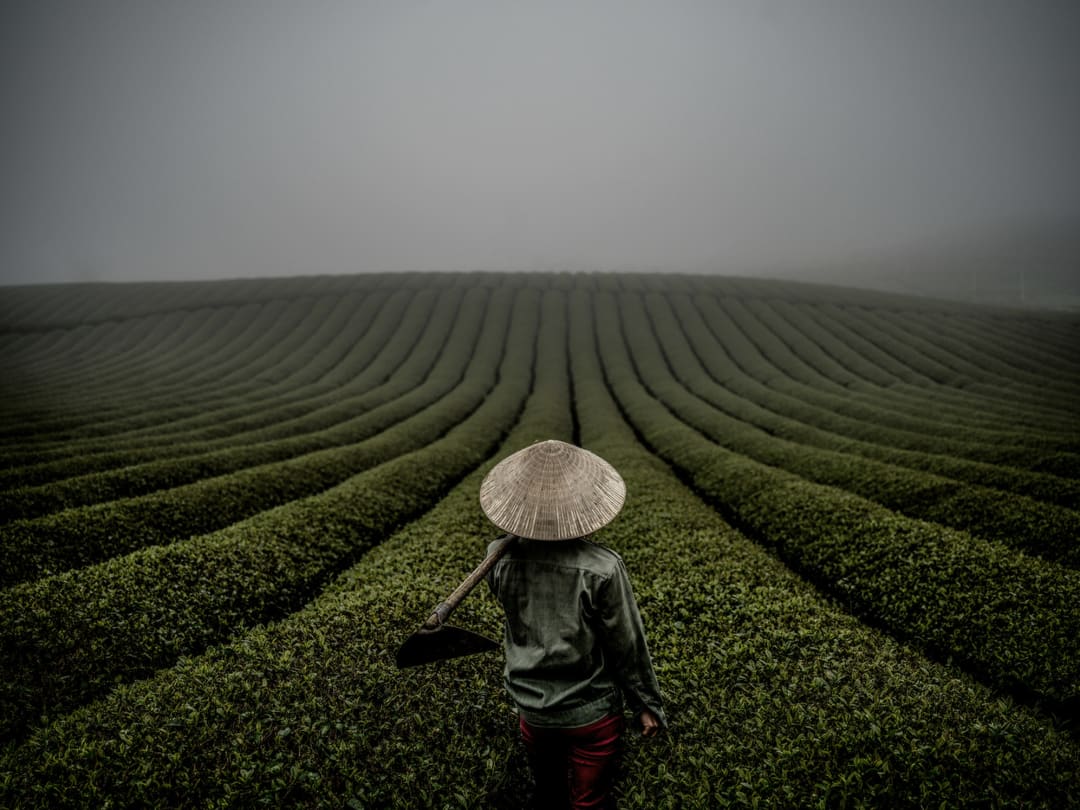
Tea country: rows you can compose with for days. Photo: Justin Mott (@askmott · justinmott.com · askmott.com)
A Note on Visas
Most Western passport holders now qualify for Vietnam's 90-day e-visa, processed online in three to five business days through the official Vietnamese government portal. Third-party services charge a meaningful premium for the same process. If you're planning the full 30 days and might extend, the multiple-entry option gives you flexibility to cross into Laos from Hà Giang or Cambodia from the Mekong Delta without restarting your visa count. Photography equipment does not require customs declaration at personal-use quantities; declare professional quantities — multiple bodies, commercial drone equipment — if you're carrying them.
Hanoi — 4 Days
Every serious photographer working in Vietnam eventually develops their own Hanoi morning ritual. Mine involves leaving the Old Quarter before 5:30am, walking north through the silk merchants' alley when the shutters are still down, and arriving at the southern end of Long Biên Bridge as the sky turns from black to indigo. The bridge runs parallel to its newer replacement and now carries primarily cyclists, motorbike delivery drivers, and the occasional train — working infrastructure rather than monument, which means the light falls on people who have somewhere to be rather than people performing their lives for cameras.
The Old Quarter rewards the same early discipline. The phở cart on Cầu Gỗ Street sets up around 5am; the flower market near Quảng Bá, technically in Tây Hồ district north of the quarter, operates from midnight until about 7am and is worth the taxi fare alone. What the standard itinerary consistently misses is that Hanoi's most productive photography windows are before 7:30am and after 6pm — the midday hours are flat, harsh, and largely wasted. Use them for editing, equipment maintenance, or sleep. Our Hanoi street photography guide covers specific locations and timing by season, including how the northern haze changes between the cool dry months (October through April) and the humid summer.
For the remaining afternoons and evenings, work the West Lake perimeter at golden hour, explore the Catholic Cathedral quarter on Sunday morning, and spend at least one evening at the Bia Hơi corner on Tạ Hiện — not as tourist spectacle but as a study in Vietnamese social geometry: the low plastic stools, the proximity of strangers, the way light from surrounding shopfronts carves faces in a scene that has operated at the same temperature for fifty years.
Ninh Bình / Tam Cốc — 2 Days
Ninh Bình has been on every Vietnam itinerary for a decade. What most visitors do: arrive by afternoon bus, take a boat through Tam Cốc, leave the next morning. What the light actually demands: arrive the evening before, position yourself at the Hang Mua lookout for sunrise, then return to the Tràng An waterway — the larger, less-trafficked UNESCO circuit — after 3pm when the tour groups have thinned and the afternoon light drops behind the karst at a usable angle.
The frames everyone shows from Ninh Bình — dramatic karst formations reflected in still water, the sweeping valley view from above — are real. The frames nobody shows are the farmers who work the paddy fields between the karsts, the buffalo crossing wooden bridges, the village life that continues at the edges of the scenic area without any awareness that it's scenic. Rent a bicycle rather than booking a boat first; the ring road around the wetlands puts you at eye level with everything the boat misses.
Pù Luông — 2 Days
Pù Luông is the itinerary's first off-map stop. Located in Thanh Hóa Province roughly four hours southwest of Hanoi, it has the terraced rice fields and minority village life of the more famous northern highlands — the Muong and Thai communities here have farmed this valley for centuries — without the infrastructure that Sapa's popularity has built around itself. There are no cable cars. The main village, Bản Hiêu, has a handful of homestays and a phone signal that drops in and out. The connectivity is the point.
For photographers, this translates directly into authentic access. Walk the irrigation paths at harvest time — typically October — and you will find people actually harvesting, not posing, not performing, because they are not yet accustomed to cameras at the scale Sapa now operates. Bring longer glass here: a 70-200mm allows you to work at respectful distances while capturing the compression of terraced fields against mountain ridges. The light through morning haze on the rice is unlike anything I've seen elsewhere in the North, a diffused gold that the sharper highland light doesn't produce.


Harvest in the northern highlands — the reason this itinerary exists. Photos: Pete Walls (@pjwphoto)
Mù Cang Chải — 2 Days
If you visit Vietnam once and want to photograph rice terraces, make it Mù Cang Chải. The terraces at Chế Cu Nha and La Pán Tẩn have a particular scale — thousands of hand-cut steps covering entire mountainsides — that exceeds anything in Ninh Bình or most of northern Laos. The optimal window is narrow: late September through mid-October, when the rice is gold but not yet harvested. Miss it by two weeks and you photograph bare mud and stubble.
The town itself is a working market hub for H'mong communities spread across the surrounding peaks. Saturday draws residents from distant villages and the informal market that forms around the bus station is more photographically interesting than anything in the organized tourist zone. Wake early, be there before 7am, and work slowly. This is a community that has not yet been exhausted by cameras — treat that trust with the care it deserves.
The frames everyone shows from northern Vietnam are real. The frames nobody shows are the village life that continues at the edges of the scenic area — operating without any awareness that it's scenic.
Hà Giang — 5 Days
This is the week that justifies the entire 30-day itinerary. Hà Giang province occupies Vietnam's far northeastern corner, bordering China, and the loop road through Đồng Văn, Mèo Vạc, and Ma Pi Leng Pass climbs to cliff edges four hundred meters above the Nho Quế River. Five days is the minimum to do it without rushing; seven would be better if you can spare it from elsewhere on the route.
Most people do the loop by motorbike, which is the correct call. Hire from Hà Giang town rather than from a tour operator in Hanoi — local rental shops know the road and the machines. The pass at Ma Pi Leng is the signature location: a sheer cliff drop to the Nho Quế River, the road carved directly into the mountain face, the kind of scale that makes every human figure in your frame feel appropriately small against geography. Arrive before the tour jeeps, which typically begin running at 9am, and you may have it to yourself in pre-dawn light and fog.
But the pass is not the point. The point is Đồng Văn Sunday Market, which draws H'mong, Lo Lo, Giấy, and Tày communities from across the plateau in traditional dress — not for tourists, but because it is the actual market they have attended for generations. The light inside the covered section is dim and directional; bring your fastest glass and accept the grain. The colors — the indigo and magenta stripes of H'mong fabric, the silver jewelry worn daily rather than ceremonially — do not read the same in any other light and cannot be reconstructed in post.
Take time to walk the Đồng Văn stone village, houses built from the same karst as the mountains around them. Stay at least two nights to be present before and after the day-trip traffic. The elevation means cold nights even in October; the cold also means fog on the valley at dawn, which does for landscape what grain does for portraiture — it renders the ordinary strange.
H'mong communities throughout the northern highlands have complex and earned relationships with cameras. Some individuals genuinely enjoy being photographed and will engage openly; others have been photographed at for years and resent it. The distinction is legible and shows in the frames. Move slowly, make eye contact, gesture permission before raising the camera. If someone declines, thank them and move on without negotiating or trying again. The best frames from places like Đồng Văn come from five minutes of genuine exchange, not from a telephoto shot taken without acknowledgment from the other side of the street.
Cát Bà Island — 2 Days
The standard route from Hà Giang goes back to Hanoi and then straight to Hạ Long Bay by overnight cruise. Skip the cruise and go instead to Cát Bà Island, the largest island in the Hạ Long archipelago. The island has a working fishing harbor, a limestone interior laced with walking trails, and a dramatically different relationship to the karst landscape than a floating hotel provides — the mountains are background here, not backdrop.
The fishing village of Việt Hải, accessible only by boat or a strenuous mountain trail with no road access, has no cars and no commerce beyond fishing. Spend a morning there, photograph the boats coming in with their catch, and understand why the fishermen here look at the same karst formations every day without finding them remarkable — background conditions for a life lived on the water. That habituation is photographically interesting in itself: a spectacle rendered ordinary by proximity.
The harbor at Cát Bà town operates best from about 5am, when the squid boats return and the fish market opens on the dock. Work the edges of the market rather than its center. The light bouncing off water and boat hulls at that hour produces the kind of unpredictable highlights and shadows that reward patience and cost nothing but sleep.

The coastal mornings between the marquee stops are where the trip earns its length. Photo: Pete Walls (@pjwphoto)
Huế — 2 Days
Huế gets one day in most itineraries. It deserves two, and a genuine photographer's approach rather than the standard citadel-plus-royal-tombs circuit. The Imperial Citadel is the obvious draw — worth the early start, the moats reflecting the walls, the gates framing interior structures with natural compression that would take hours to set up artificially — but Huế's most productive photography happens elsewhere.
Đông Ba Market, just northeast of the Citadel, opens before dawn and runs at full pace by 5am. It is a working market with no tourism infrastructure, which means vendors are focused on trade rather than on you. The covered section has beautiful directional light through gaps in the corrugated roof; work it with a 35mm and you have frames that look nothing like the citadel postcards that define every Huế travel piece. The canal outside, with the Perfume River in the background, sits in golden light for about forty minutes before the sun gets harsh.
The Royal Tombs south of the city are worth an afternoon — not for the tombs themselves, which have been heavily restored to a formal state, but for the temple life that continues in the surrounding villages. Huế carries a quality of ceremonial seriousness that the coastal cities don't have; it was the imperial capital and that history is still legible in how people move through it.
Hội An — 2 Days
Hội An is the most photographed city in Vietnam, which means the bar for an original frame is high and the pre-dawn visit to the ancient town is non-negotiable. By 8am the tourist infrastructure is fully active; the lanterns and the Japanese Bridge are swamped. By 5:30am you may have thirty minutes of quiet light on those streets before the first arrivals appear — light falling on the facades without competing with manufactured ambiance or other cameras.
The more interesting photography in the Hội An area is at the estuary fishing village immediately north of town, where round basket boats (thúng chai) operate at dawn. These are working vessels and the fishermen using them are skilled craftspeople, not performance artists — the challenge is to photograph the work without aestheticizing the workers into props. Walk along the bank rather than hiring a boat; ground level gives you the boats against the horizon rather than looking down at them from above, which is the angle every tour photograph uses.
Quy Nhơn — 2 Days
Quy Nhơn is this itinerary's truest off-beaten-path stop, and the one most likely to be cut when schedules compress. Don't cut it. A medium-sized coastal city in Bình Định Province, it has excellent beaches, a significant Cham cultural heritage — the Tháp Đôi towers are twelfth-century Cham structures, lit by the setting sun at an angle that makes the ancient brickwork glow — and a local food scene operating almost entirely for residents rather than visitors. The highway doesn't conveniently pass through it; you make a deliberate choice to be here, and that deliberateness changes how you photograph.
The fishing harbor at Nhơn Lý village, accessible by road north of the city, operates an active boat fleet departing around 4am. The light on the harbor in that pre-dawn window — boats moving out, the breakwater silhouetted, the sky running through blues before the sun clears the horizon — is the kind of frame that doesn't appear in guidebooks but exists in reality, available to anyone willing to set an alarm. The small night market near Quy Nhơn's central beach is worth one evening walk with a wide lens and no agenda.
Hồ Chí Minh City / Saigon — 3 Days
Saigon operates at a different speed than any city in the North. The light is harsher and more equatorial — less of the northern haze, more direct sun — which shifts the productive windows: before 7am and the full golden hour before sunset. Midday in Saigon in any season is punishing for both photographer and subject, and the results look like it.
Work Bình Tây Market in Chợ Lớn rather than the tourist-facing Bến Thành. Chợ Lớn, Saigon's Chinese quarter, operates a scale of wholesale trade — goods stacked floor to ceiling, the smell of dried seafood and spice, the sound of handcarts on concrete — that Bến Thành has long since traded for the souvenir economy. District 4, immediately south of the river, has the alley food scene, the narrow wet streets, the density of Vietnamese urban life operating without tourist mediation. Our Saigon street photography guide covers the specific timing and approach for each district, including where the best evening light falls and which neighborhoods reward the second visit more than the first.
Spend one evening on the rooftop of a building in District 1 watching the traffic below — not to photograph it from above, but to understand the patterns before you go down into them. Saigon from street level is chaotic in ways that reward preparation. Know where you're going before the light changes.
Mekong Delta — 3 Days
End the 30 days on the delta, which most itineraries treat as a day trip from Saigon and therefore miss entirely. Cần Thơ is the delta's largest city and the base for Cái Răng floating market — the most photographed market in the south, still worth it if you take the right boat at the right hour. The market operates fully from about 5am; boat operators will tell you 6am because that is when the light is comfortable for most people. Leave at 5am anyway and work in the pre-dawn blue while the market is still focused on trade rather than tourism.
The real delta photography happens off the main waterways. Hire a local guide with a small boat and navigate the side channels — the rice paper making villages near Vĩnh Long, the palm sugar operations, the boat repair yards where skilled workers spend entire careers on the same stretch of river. Trà Vinh province, east of Cần Thơ, has a significant Khmer population and a network of pagodas architecturally distinct from the Vietnamese Buddhist temples you have spent the previous weeks photographing: different geometry, different color, a different relationship to the surrounding flatness.
Three days barely scratches the delta. But it ends the 30-day itinerary with something the North can't offer: heat, flatness, water in every direction, and a photographic subject — the delta's people and their relationship to the river — that has been operating at its own pace for centuries and will continue to do so long after the cameras are gone.
- Apply for your 90-day e-visa at least five business days before departure — the official government portal processes faster and cheaper than any third-party service
- For Hà Giang, hire a motorbike locally in Hà Giang town rather than booking a tour from Hanoi — the flexibility to stay longer at locations that reward it is worth more than the guided logistics
- Mù Cang Chải's golden rice season runs late September to mid-October only — verify harvest status with local guesthouses before committing your travel dates around it
- Bring fast glass (f/1.4 or f/1.8 in 35mm or 50mm equivalent) for market interiors and pre-dawn harbor work — the light in these environments does not accommodate slower lenses without unacceptable compromises on ISO
- Carry small prints of your portraits to offer people you photograph in the northern highlands — it costs almost nothing to print in Hanoi and opens conversations that no amount of charm otherwise will
- Check the Vietnam Streets community before you go — our members collectively cover every location on this route and studying frames from the same spots in advance changes how you see them when you arrive
Photography spots in Vietnam off the beaten path are rarely hidden in any geographic sense. Most are operating in plain sight, at hours or on days that the standard itinerary simply doesn't account for. The 30-day structure here is a skeleton, not a prescription — add days anywhere the light is working, leave early from anywhere it isn't, and miss the bus without guilt when the frame demands it. The best itinerary is always the one you're willing to revise.
The Streets & Stories newsletter features the strongest street photography from across Vietnam each week, and much of the work that makes it in comes from exactly the kind of deliberate, off-circuit access this route is built around.
Vietnam Streets is a curated community documenting Vietnamese street life. Submit your work — selected photographs join the 840+ already published here from 170+ photographers.
Submit Your Work →Frequently asked questions
How long is this off-the-beaten-path route?
Thirty days and roughly 2,500 kilometers, from Hanoi to the Mekong Delta. Where the backpacker circuit prioritizes efficiency, this route prioritizes the hour before sunrise and the village past the end of the paved surface.
What are the best hours to shoot along the way?
Before 7:30am and after 6pm. The midday hours are flat, harsh, and largely wasted, so the productive windows sit at the edges of the day — a pattern that holds across most of the itinerary.
What season suits this itinerary?
The cool dry months, October through April, give clearer northern light and haze that reads as atmosphere; the humid summer brings heavier air and harder overhead light.

One photographer an issue. Free, and no spam.
No spam. Unsubscribe at any time.