Field Notes
Mekong Delta Photography Guide

Boats loaded with produce, seen from a bridge. Photo: Lâm Xuân Tùng (@tungxuanlam_street)
The first boat engine startles you at 4:15 in the morning — a low diesel churn cutting through the dark water outside your guesthouse window in Can Tho. By the time you've pulled on your boots and found the dock, a dozen wooden boats are already moving through the canal, navigation lights blinking red and green in the pre-dawn black, vendors stacking fruit in the yellow glow of a single bulb hung from a bamboo pole. You've been told about the floating markets of the Mekong Delta. Nothing quite prepares you for the smell of it — diesel and wet wood and ripe mango — or for the realization that most of the trading will be done before the sun clears the treeline.
The Mekong Delta is not a place you arrive at so much as a place that absorbs you. Drive south from Saigon and within two hours the land begins to flatten and soften, the highway splitting around rivers that have no interest in following a road's logic. The canals appear first in glimpses between banana groves, then everywhere at once, threading between rice paddies and village markets, under wooden bridges barely wide enough for a motorbike, past houses built on stilts at the water's edge with their back doors opening directly onto the current. By the time you reach Can Tho, the Delta's largest city, you've crossed a dozen waterways that don't appear on most maps.
Why the Delta Rewards a Different Kind of Patience
Most photographers come to Vietnam for Hanoi or Saigon, and both cities earn that attention — the Old Quarter's compressed chaos, the motor-oil light at dusk on a Saigon boulevard, the women in áo dài moving through traffic with a kind of practiced grace. But the Mekong Delta offers something those cities can't: a pace. Life here operates on the rhythm of the river, which is slower and more predictable than city life, and the photography that results tends to have more room in it — more breath in the frame, more time in the eyes of the subjects.
That said, slow doesn't mean easy. The Delta's best images require logistics — boats, early mornings, the ability to navigate between what's tourist-facing and what's genuinely working. The floating markets, the lily harvests, the coconut candy factories tucked inside river bends: none of these wait for you. They operate on their own schedules, and understanding those schedules is most of the craft.
Floating Markets: What Remains, and What to Do With It
Cai Rang floating market, a few kilometers southwest of Can Tho along the Cai Rang River, is the most photographed scene in the Delta. Its reputation as a tourist destination is both accurate and worth examining. The wholesale trading that once defined these markets has contracted significantly — most wholesale now moves by road — and the morning scene at Cai Rang is increasingly supported by the tourist economy. You'll see vendor boats selling coffee and bánh mì to the tourist longboats that circle from 6 AM onward, and some merchants have adapted their layouts with a photogenic awareness that's hard to miss.
None of which means the photographs aren't worth making. Cai Rang still functions as a retail market for the surrounding communities, and if you're on the water before 5:30 AM, before the longboats arrive in numbers, the scene is genuinely busy — merchants calling across the water, a woman steering her boat with one foot while she arranges a tower of pomelos, a man in a conical hat arguing about the price of water hyacinth stems. The tourist layer arrives over the market, not instead of it.
The practical approach: hire a private boat rather than joining a group tour. A small wooden vessel, hired through your guesthouse for a couple of hours before dawn, lets you stop when you want and approach angles that a longboat's fixed route doesn't allow. Ask the boat driver to cut the engine when you're photographing — the noise makes it harder to read a scene, and some of the most expressive market moments happen in that relative quiet, when vendors aren't performing for the tourist boats circling behind you.
Phong Dien market, further from the city center along Phong Dien canal, is smaller and less visited, with fewer tourists at most hours. It's a better choice if what you're after is unmediated daily commerce — the trading is purely functional, the vendors have no particular interest in your camera, and the light on that canal at 6 AM in the dry season goes flat and silver-white, turning everything it touches into graphic shapes.
Get on the water before 5:30 AM, before the tourist longboats arrive in numbers. The commercial layer that remains is real — you just have to meet it on its own terms.
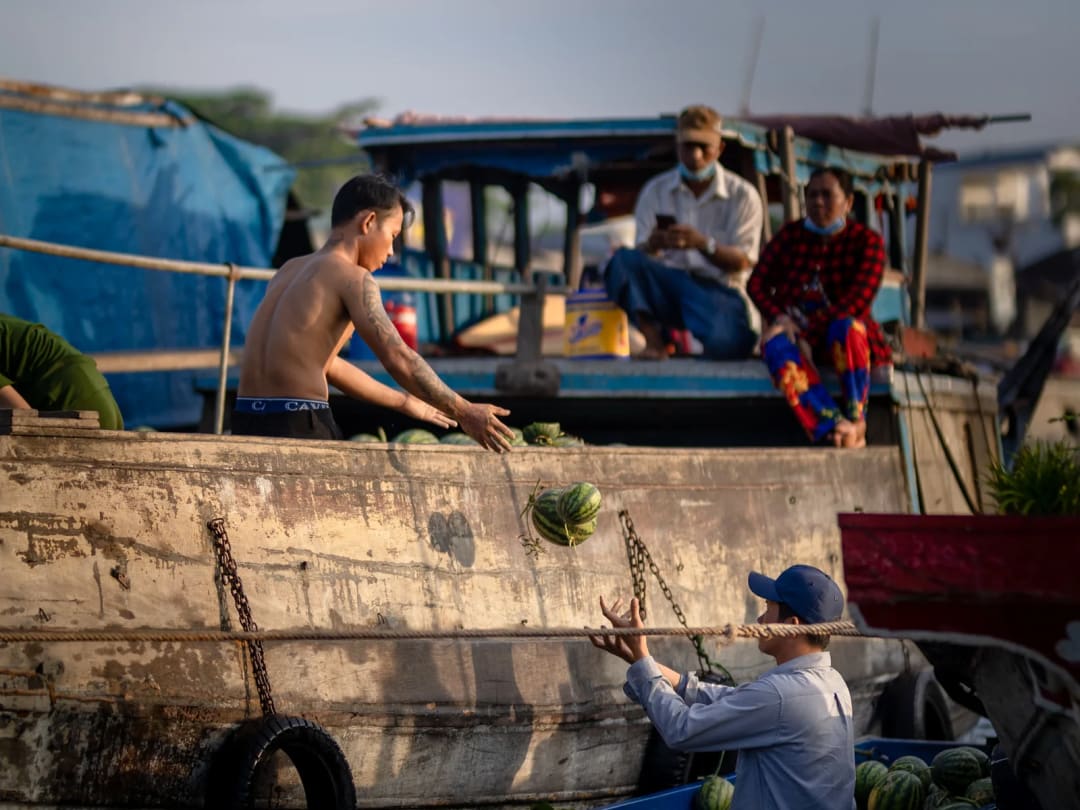
The floating markets work on boat time, not tourist time. Photo: Jimmy Ky (@kyjimmy)
The Lily Harvest: A Window That Opens Once a Year
Between October and December, the annual flood pulse from upstream swells the low-lying plains of Long An and Dong Thap, and water lilies bloom across them in wide pink and purple sheets. This is among the most visually striking agricultural scenes in Vietnam — women wading waist-deep through the flowers, gathering bundles of stems and blossoms that will be sold at morning markets as a food ingredient. The lotus season in Central Vietnam gets more international attention, but the lily harvest in the southern Delta is less visited and arguably more photographically rich, because the scale of the flooding creates settings where the earth and sky appear to merge at the horizon.
Sa Dec and the surrounding areas of Dong Thap province are the most productive hunting grounds. The harvest begins at first light and is largely finished by 8 or 9 AM, when the heat becomes punishing. Arrive before dawn, position yourself low — knee-level if you can manage it on a boat or a bank — and shoot into the light. The mist that sits on the water in the early morning hours is most reliable in October and November, and when it's present it reduces everything to silhouette and color: the hot pink of the flowers, the dark shapes of the women, the gray-white sky above.
A 70–200mm or 85mm prime gives you the compression to collapse the distance between foreground and background without feeling intrusive. Many of the women working the harvest are accustomed to photographers during the season and will let you approach, but ask through your boat driver first — the physical work of the harvest is demanding, and interrupting it to pose can feel extractive in a way that undermines the photograph anyway. The images that hold up are the ones made when the work is happening and you've simply been given permission to be present for it.
The flood season that fills the lily fields also limits road access to much of Long An and Dong Thap. Travel by boat is often the only way to reach the best harvest locations, which means logistics must be planned the evening before — the boat, the driver, the starting time. Local guesthouses in Sa Dec and Cao Lanh can arrange drivers who know which fields are harvesting on a given morning, since the harvest rotates through different areas over the season. Ask specifically for drivers who work the flower fields regularly, not general tourist boat operators.
Sa Dec and the Flower Nurseries
Most visitors know Sa Dec through Marguerite Duras — the French colonial house on the riverfront, the story of her relationship with the Chinese merchant's son, the novel that made this unremarkable Delta town famous in ways its residents regard with mixed feelings. For photographers, Sa Dec's more useful distinction is its flower nurseries. The town and its surrounding villages produce a significant share of Vietnam's ornamental flowers, and in the weeks before Tết — the lunar new year, falling in late January or early February — the fields and nurseries fill with colour for the Tết flower trade.
In non-Tết seasons the nurseries are quieter but still active, with workers transplanting seedlings, mixing soil, loading blooms onto boats for delivery to markets in Can Tho and Saigon. The light in the early morning here is gentle and directional — the flat Delta landscape means the sun rises without obstruction and the first hour offers warm raking light across rows of flowers that makes even a mediocre composition feel alive. A 50mm prime at f/2.8 and a willingness to walk the rows slowly gets you further than any particular technique.
The Tết flower market on the Sa Dec riverfront, held in the two weeks before the holiday, is worth planning a trip around. Boats laden with chrysanthemums, marigolds, and ornamental kumquat trees crowd the waterway; buyers examine blooms with the concentration of art collectors; children run between the stalls in their best clothes. It's one of the more exuberant street scenes in southern Vietnam, and the condensed space of the riverfront — everything compressed between the water and the market stalls — creates natural frames that reward a wide angle and a patient approach. Show up for two or three consecutive mornings and you'll start to see the scene rather than just photograph it.
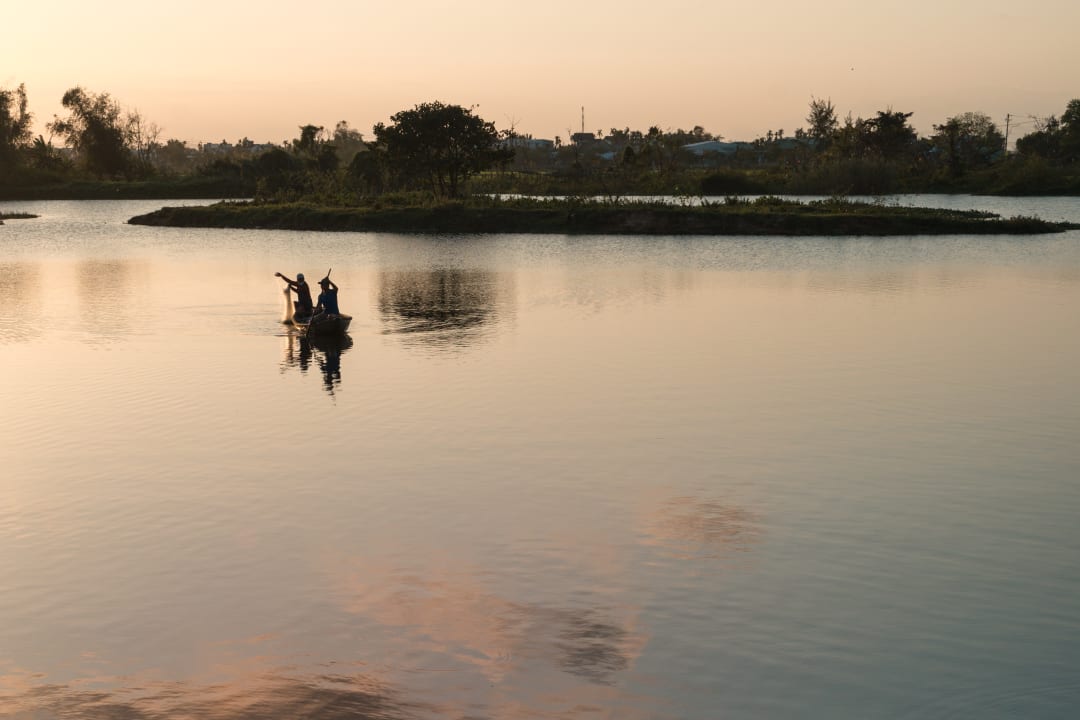
Between the markets, the delta is mostly this — water doing nothing in particular, beautifully. Photo: Pete Walls (@pjwphoto)
Canal Villages and the Life Between the Markets
The Delta's most honest photographs don't always come from the obvious set pieces. Equally strong work comes from the long middle of the day, when the floating markets have quieted and the lily fields are empty, and you take a boat into the smaller canals that branch off the main waterways. In these channels — barely wide enough for two boats to pass — the pace shifts completely. A woman hangs laundry from a line strung between two coconut palms. A man repairs a net on his front steps, his house built on concrete pilings directly over the canal. Children watch from doorways with the particular alertness that kids in working villages have, neither hostile nor performing.
The coconut candy factories of Bến Tre province deserve specific mention. These small workshops — often family operations that have run for generations — process coconut milk into the chewy, sesame-coated candies that are one of the Delta's signature products. The interiors are hot and fragrant and visually chaotic in the best way: giant copper pots, women in rubber gloves working molten candy against wooden boards, piles of wrappers and packaging on every surface. Many workshops in the tourist district of Bến Tre town welcome photographers as a matter of course, but the workshops in surrounding villages, reached by boat through the coconut groves, are quieter and more willing to simply let you stand and watch.
This kind of access — where work is happening and you've simply been given permission to be present for it — is documented across Vietnam in the Field Notes archive on Vietnam Streets. The dynamic of photographing working spaces where tourism hasn't yet flattened the activity is consistent from the Delta's candy factories to Hanoi's craft streets, even as the craft itself changes. What stays constant is the approach: go slowly, go repeatedly, buy something before you raise the camera.
Light, Season, and When to Go
The Delta operates on two distinct visual registers depending on the season. The dry season — roughly November through April — offers cleaner air, sharper light, and easier boat access to most areas. The sun rises early, the midday light is brutal but the golden hours are extended and dependable, and the water levels in most canals are low enough to navigate comfortably. This is when the canal architecture is most legible: the pilings, the wooden bridges, the stilt houses reflected in still water.
The wet season — May through October — transforms the landscape entirely. Water levels rise dramatically, flooding fields and roads, and the lush green of the rice paddies and banana groves intensifies to something almost fluorescent. The afternoon light is often diffused through cloud cover, which is excellent for documentary work — softer shadows, more latitude in the exposure, faces that don't squint against the glare. The lily harvest is a wet-season phenomenon, as is the river fog that settles on the water in the early morning hours and turns even an ordinary canal scene into something worth framing.
For photographers specifically, the shoulder months — October and April — offer the best of both conditions. October catches the beginning of the lily season before tourist awareness peaks, and the air has enough moisture to create atmospheric haze without the full difficulty of wet-season logistics. April, just before the monsoon arrives, has long golden hours and low water that makes the canal infrastructure most visible and most photogenic.
Compare these conditions to shooting in Saigon, where urban density creates its own microclimate and the most interesting light is often reflected off buildings, underpasses, and wet pavement rather than open water. The Delta is the inverse — light comes from everywhere at once because the water is everywhere, and the open landscape means there are no urban canyons to retreat into during the harsh midday hours. You plan around the light here more consciously than anywhere else in Vietnam.

Sampans in the coconut shade — the delta’s quietest compositions are at the edges of the day. Photo: Pete Walls (@pjwphoto)
Gear for the Conditions
The humidity in the Mekong Delta — particularly in the wet season — is not the dry heat of a hot day but a persistent atmospheric pressure that settles into everything. Fungus grows on unprotected glass in weeks. Silica gel in your camera bag is not optional. If you're shooting for multiple days during the rainy season, pull your lenses out each evening, let the bag air, and check for fogging on rear elements before each session. A small desiccant box for overnight storage is worth the weight.
For floating market work, a weather-sealed body makes the difference between a photograph and a failed photograph — boat spray, rain, the condensation that comes from moving between air-conditioned guesthouses and 90% humidity outdoors. A prime in the 35–50mm range is the working lens for boat-to-boat shooting, where the distances are close and the movements unpredictable. For lily harvest work, a longer lens — 85mm to 200mm — lets you compress the field and pull the women working against the background of flowers without requiring you to be standing in the water alongside them.
- Arrange boat access through your guesthouse the evening before — good drivers book early, especially during lily season (October–December)
- Pack silica gel sachets and check rear lens elements for fogging in high-humidity months; a desiccant box for overnight storage is worth it on multi-day trips
- Research Tết flower market dates if Sa Dec is your priority — the market runs for roughly two weeks before the holiday and timing shifts year to year
- Confirm which floating markets are operating: Phong Dien runs daily but peaks Thursday and Sunday; Cai Rang is daily but the wholesale activity is largely finished before 7 AM
- Bring small bills for market vendors — buying something before photographing is both ethically sound and practically useful for access in smaller communities
- Check recent shooting reports in the Vietnam Streets community — photographers who've been there recently often share timing, access notes, and which fields are actively in harvest
The Delta in the Broader Vietnam Photography Conversation
Much of the photography advice circulating about Vietnam focuses on the north — Hanoi, Sapa, Ha Long Bay, the motorbike terraces of Mù Cang Chải. This is understandable: the light in the north is more dramatic, the landscape more vertical, the cultural heritage more visually legible to international audiences. But the Mekong Delta is where a different and arguably more intimate version of Vietnamese life is happening, and it rewards photographers who've done enough work in the country to move past the canonical images.
If you've spent time shooting in Hanoi and found yourself looking for something that doesn't feel pre-framed — that doesn't have the Old Quarter's obvious compositional logic or the theatrical chaos of a Saigon intersection — the Delta is the answer. The images are harder to make and easier to make badly, but when they work, they have a quality that is specific to this landscape.
Photographers working on long-term documentary projects across Vietnam tend to return to the Delta repeatedly — not for a single image but for the slow accumulation of a place. The way the light changes by month. The way access opens as you become a familiar face on a given canal. Three days in the Delta gets you tourist photographs. Three weeks gets you something else.
If you're working the Delta and making images you're proud of, the Vietnam Streets community welcomes that kind of documentary commitment. Submit your photography — work that gets selected reaches 7,000+ followers paying attention to what's being made in this country, and the Delta is barely represented in what comes in — three submissions out of three hundred.
Vietnam Streets is a curated community documenting Vietnamese street life. Submit your work — selected photographs join the 840+ already published here from 170+ photographers.
Submit Your Work →Frequently asked questions
What time should I reach Cai Rang floating market?
Get on the water before 5:30 AM, before the tourist longboats arrive in numbers. Cai Rang still functions as a real retail market for the surrounding communities, and at that hour the trading is busy with real retail and the canal light is still low.
When and where is the water-lily harvest?
Between October and December the annual flood pulse swells the low-lying plains of Long An and Dong Thap and water lilies bloom across them. Sa Dec and the surrounding areas of Dong Thap are the most productive; the harvest begins at first light and is largely finished by 8 or 9 AM, and the early-morning mist is most reliable in October and November.
Is it okay to photograph the lily harvesters?
Many of the women working the harvest are accustomed to photographers during the season and will let you approach, but ask through your boat driver first. The work is physically demanding, and interrupting it to pose can feel extractive in a way that undermines the photograph anyway.
When is the best time of year for the Mekong Delta?
The dry season gives stable canal light and access, while October to December specifically brings the lily harvest and the most reliable early-morning mist. Note that the same flood that fills the lily fields also limits road access to much of Long An and Dong Thap.

One photographer an issue. Free, and no spam.
No spam. Unsubscribe at any time.