Field Notes
Travel Photography in Vietnam
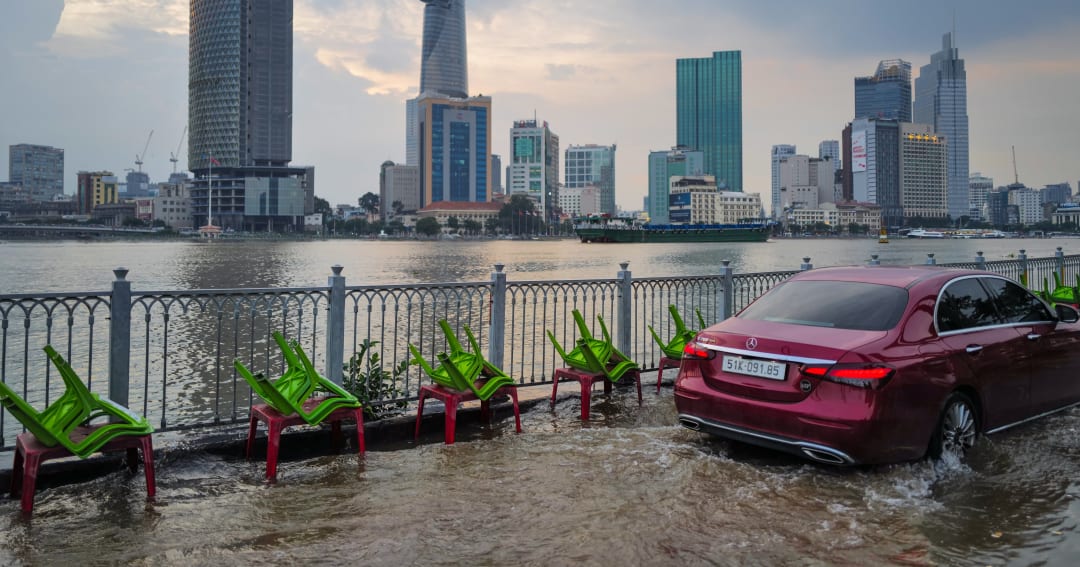
The Saigon skyline in the rain. Photo: Le Hoang Tuan (@acuriousobserver_)
The bus from Nội Bài deposits you on Đinh Tiên Hoàng at 5:47 in the morning, and Hanoi is already awake — not in the vague, coffee-and-commute sense most cities wake up, but awake in the way that matters to photographers: vendors arranging pyramids of pomelo under sodium vapor lights, a woman balancing bánh mì on a shoulder pole, the first motorbikes threading through mist rising off Hoàn Kiếm. You haven't slept. Your sensor is fresh. This is Vietnam's opening argument, made to every photographer who arrives here for the first time, and it rarely disappoints.
Vietnam Doesn't Give You Easy Pictures
Let's get the romantic part out of the way: Vietnam gives a photographer a great deal to work with. The density of visual material — the layered street life, surviving French colonial architecture pressed against new construction, the light quality that shifts entirely between the north and south — is unlike almost anywhere else in Southeast Asia. There are strong frames here for the taking.
But Vietnam will also humble you if you're not deliberate. It's easy to spend a week shooting bánh mì carts and conical hats and leave with 3,000 frames that don't add up to anything. The country rewards photographers who come with a plan, who understand why they're pointing the camera somewhere, and who take time to understand the cultural context they're working in.
This isn't a beginner's guide. This is for photographers who've worked street before and want to understand what makes Vietnam specifically different — the light, the geography, the human dynamics, the seasonal realities — before they land.
The City You Start In Will Shape Your Whole Trip
Most photographers enter Vietnam through either Hanoi or Ho Chi Minh City, and which you choose first will calibrate everything about how you see the country.
Hanoi is older, slower, more layered. The Old Quarter — 36 guild streets, each historically named for the trade practiced on it — operates at a pace that rewards patience. You can post up on a corner of Hàng Bè or Hàng Đồng for an hour and watch the whole economy of the street cycle past. The light in Hanoi is often diffuse: northern humidity creates a natural softbox effect that makes morning and late afternoon shooting feel effortless. The challenge is density — finding a frame without seventeen motorbikes in it requires either very early mornings (before 6:30am on weekdays) or a different compositional approach entirely.
Ho Chi Minh City is velocity. Saigon doesn't have neighborhoods in the way Hanoi does — it has districts that bleed into each other, each with its own texture. District 1 is commerce and chaos. District 3 is colonial-era villas and working cafés. Bình Thạnh has the layered, verticalized street life that photographs well from mid-level vantage points. The light in the south is harder — higher sun angle, less atmospheric diffusion, more contrast — and the golden hour is genuinely golden but brutally short. Work fast.
If you're on your first visit and can only choose one city to shoot seriously, read our dedicated guides to shooting in Hanoi and shooting in Saigon before you land. Each city demands a different set of instincts.
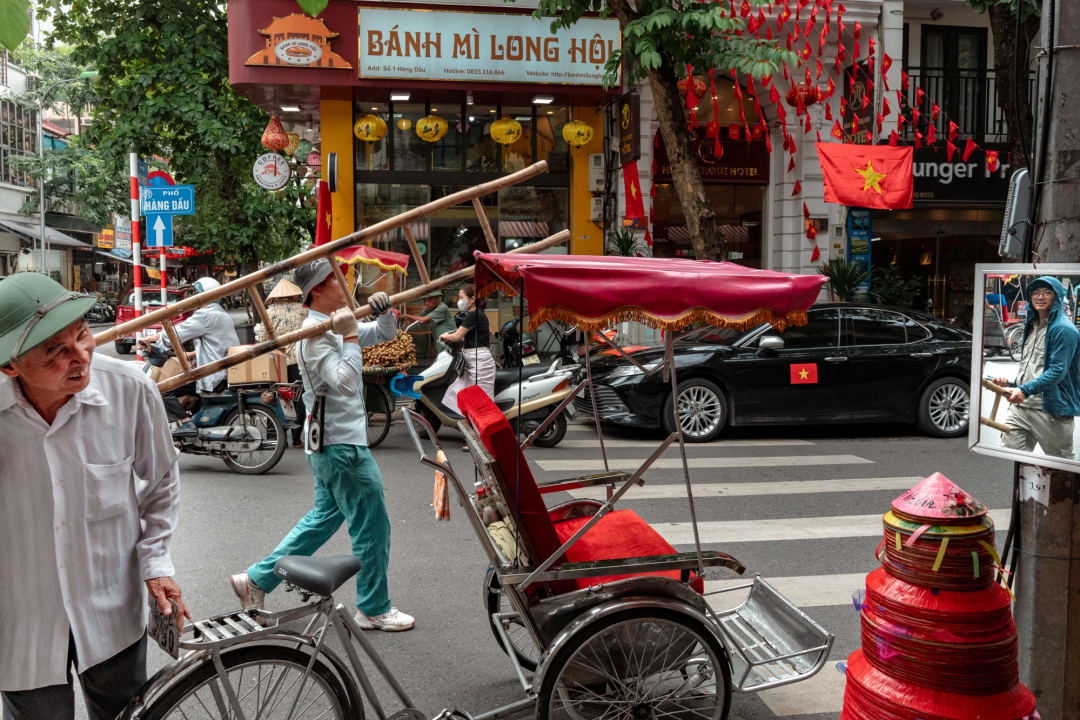
The everyday logistics of Vietnam are half the photographic story. Photo: Antonio di Vico (@iamvagaboots)
What to Photograph on Your First Visit to Vietnam
This is the question most first-timers ask, and most answers fail because they list subjects rather than situations. Subject lists give you a checklist. What you actually need is an understanding of where photographic meaning tends to concentrate in Vietnam — and why certain subjects reward time that others don't.
Morning Markets
Every photographer shoots morning markets in Vietnam, which means you need to shoot them differently. Chợ Đồng Xuân in Hanoi is the most famous and consequently the most photographed — arrive before 5:30am if you want to work the wholesale hour before the tourist trade begins. In Saigon, Chợ Bình Tây in Cholon (District 6) operates at a scale and intensity that Bến Thành doesn't — the wholesale floor between 4 and 6am offers low working light, genuine labor, and almost no other photographers.
The stronger photographs from markets rarely come from the stalls themselves. They come from the edges: the delivery moment, the vendor eating her own breakfast, the cart wheeler navigating a gap that shouldn't exist. Shoot the periphery.
Street Food as Documentary Subject
Phở at dawn, bún bò Huế at a plastic stool pushed against a wall, cà phê trứng being poured in a Hoàn Kiếm-side shop that's been there since 1946 — Vietnamese street food culture is photographic not because it looks good but because it's communal and revealing. The way people sit, who they sit with, what they do with their hands while waiting — this is behavioral documentary territory, not food photography.
The café culture is particularly rich. Vietnamese coffee culture involves a level of lingering unusual in the region — people sit for hours, and a café corner gives you a fixed point from which to work a whole social ecosystem without constantly repositioning. Order your cà phê sữa đá, stay for two hours, and watch what comes through the frame.
Workshop Districts and Living Trades
The trades are still alive in Vietnam in a way they aren't in most developing economies. In Hanoi's Old Quarter, Hàng Thiếc (Tin Street) has metal fabricators working in doorways open to the street. The frame-and-mirror district near Hàng Khoai involves artisans whose work photographs beautifully under mixed fluorescent and natural light. In Saigon, the cabinet-making district along Lý Thường Kiệt in District 11 offers genuine workshop interiors — not staged for tourism, not particularly aware of being photographed.
For craft work, a 50mm equivalent gives you the right compression to isolate a face or pair of hands without the distortion of going too wide. Don't rush the frame — the moments come from watching the work rhythm, not interrupting it.
The Motorbike Economy
You'll photograph motorbikes whether you intend to or not. Vietnam has approximately 45 million registered motorcycles, and they carry everything: live pigs, bedroom furniture, propane tanks, wedding cakes, children asleep on their fathers' backs. The challenge is moving past the chaotic-traffic frame — which is real but reductive — and into the individual stories being transported through your field of view.
At major intersections in Hanoi's Old Quarter, try positioning yourself slightly elevated — a café staircase, a second-floor window — and shooting down into slow-moving traffic. At f/8 and 1/30s you'll get motion blur on the bikes while keeping riders' expressions sharp. The result reads more like the felt experience of the city than a frozen moment ever will.
Reading Vietnam's Light by Region
Light in Vietnam behaves differently depending on which part of the country you're in, and understanding this before you land will save you from wasting your first mornings in the wrong place.
The North (Hanoi, Hà Giang, Sapa): The northern climate produces a characteristic soft, diffuse light for much of the year — particularly in the winter months (November through February), when cool mist sits low over the Red River Delta. This is not the golden-hour drama photographers expect. It's something more like a perpetual open shade, which means you can shoot all morning, not just the first hour after sunrise. Midday in Hanoi in December is workable in a way that midday in Ho Chi Minh City in April is not.
The South (Saigon, the Mekong, Phú Quốc): The south has two distinct seasons, and both have photographic implications. The dry season (November through April) brings hard, high-contrast light and clear skies. Golden hour is brief and dramatic. The wet season (May through October) brings afternoon thunderstorms that clear inside a 30-minute window — wet streets reflecting neon, the sky going green before blue, is the shooting the wet season is worth putting up with.
Central Vietnam (Đà Nẵng, Hội An, Huế): The central coast sits between both systems. Hội An's famous yellow-walled lanes photograph best in the hour before 8am, before day-trippers arrive from Đà Nẵng. Return in the late afternoon when the heat has pushed most tourists inside — the ancient town has a different light and a different population after 4pm.

The coast works at dawn. Be there before the light is. Photo: Pete Walls (@pjwphoto)
Cultural Context You Can't Photograph Without
Vietnamese attitudes toward being photographed are not uniform, and they've shifted noticeably in the last decade. In heavily touristed areas — the Hội An lantern streets, Hoàn Kiếm Lake on a weekend — local subjects have learned to either perform for cameras or deflect them. You'll feel this immediately. Neither dynamic produces photographs worth keeping.
The more interesting photographic reality is in the middle distances from tourism. In residential neighborhoods — Tây Hồ at 6am, the Bình Thạnh backstreets in Saigon, hill villages around Sa Pa — people are neither performing nor deflecting. They're working, and you're a peripheral observer. Arrive early enough and you'll be simply another person on the street.
On asking permission: Vietnamese culture around photography varies by age and region. Older women in the north, particularly market vendors, are often the most camera-aware and can be among the most direct in their refusals or welcomes — a smile, eye contact, and a gesture toward your camera is usually received honestly. Younger urban Vietnamese are generally comfortable being photographed. The key is reading the moment before you raise the camera, not after it's already up.
At religious sites: Buddhist pagodas and temples throughout Vietnam are working places of worship. If you're shooting inside, dress appropriately, stay out of the path of people praying, and avoid the altar directly without the caretaker's permission. The stronger photographs from religious sites almost always come from the courtyard margins anyway — incense smoke, the backs of worshippers, light through a narrow doorway.
The Field Notes gets into these dynamics neighbourhood by neighbourhood.
Gear That Actually Survives Here
Vietnam is hard on cameras. Hanoi in August, Saigon in April, the Mekong in July — all produce the kind of ambient humidity that fogs elements and grows mold in bodies left sitting. Gear that works here shows the climate and keeps performing. It's worth thinking through before you pack.
The photographer on a first visit doesn't need more than one body and two lenses — or honestly, a single zoom covering 24–70mm equivalent. The country is so visually dense that your main limitation will be attention and selection, not focal reach. A compact mirrorless system (Fujifilm X-series, Sony A7C, OM System OM-5) will serve you better than a full-frame DSLR because you'll actually carry it everywhere. The camera left at the hotel because it's heavy is the camera that makes no photographs.
For street work specifically: f/2 or faster lets you work the indoor-outdoor light transitions that define Vietnamese street life — a workshop opening directly onto a bright alley, a dark coffee shop interior against a sun-blasted sidewalk. Auto-ISO with a ceiling of 6400 will get you through most situations cleanly on any modern sensor.
- Pack silica gel packets and store your bag in air conditioning overnight — tropical mold on optical glass is irreversible
- A shoulder bag is less conspicuous than a camera backpack in urban Vietnam, and more comfortable in the heat
- Download offline map tiles for your shooting neighborhoods before landing — data coverage is good but not universal
- Budget at least two full shooting days per city — one day is tourist time, not working time
- Customize your quick-access controls (ISO, aperture, EV compensation) before you land — the frame that happened while you were in a menu is the one you'll remember missing

The frames that hold up are the ordinary ones made carefully. Photo: David Lund (@david-lund.com · @davidlund_photography · The Southern Photo Club)
Building a Body of Work, Not a Highlight Reel
The hardest thing about photographing Vietnam for the first time is resisting the pull to cover ground. Vietnam is 1,650 kilometers from end to end, the bus and train networks are reliable, and budget airlines connect the major cities cheaply. First-timers routinely spend two weeks and hit five cities. The photographs from those trips are technically competent, geographically diverse, and narratively empty.
The photographers whose work consistently resonates in the Vietnam Streets community — 170+ photographers published here — are the ones who stayed somewhere. Who shot the same market three mornings in a row. Who went back to the same tea vendor on day four and got the portrait they'd been working toward since day one. Depth over breadth is the only approach that produces work worth showing.
This is also practical advice: you need time in a place for subjects to stop reacting to your camera. Most people become ambient rather than a photographic event after two or three days of regular presence. The third morning is when you start making real photographs.
The photographers whose work stays with you aren't the ones who covered the most ground. They're the ones who understood one corner of Vietnam well enough to photograph it honestly.
Where to Go From Here
Vietnam is not a destination you exhaust on a first visit. It accumulates — every return adds a layer to what you understand about it photographically. Covering it properly takes years of returns.
Start with one city, one neighborhood, one hour of the day. Work the dedicated guides to shooting in Hanoi or shooting in Saigon for neighborhood-level specifics. Explore the Field Notes archive for the city guides and craft essays. When you've got frames worth showing, the Streets & Stories newsletter is where Vietnamese street photography is taken seriously as the documentary practice it is.
Vietnam will show you things you don't yet know how to photograph. That's the point of going.
Vietnam Streets is a curated community documenting Vietnamese street life. Submit your work — selected photographs join the 840+ already published here from 170+ photographers.
Submit Your Work →Frequently asked questions
Does it matter which city you start in?
Yes — the city you start in shapes your whole trip. Saigon's District 1 is commerce and chaos, District 3 is colonial-era villas and working cafés, and in Hanoi you can post up on a corner of Hàng Bè and watch the whole economy of the street cycle past.
How do you avoid crowded, motorbike-filled frames?
Density is the real challenge — finding a frame without seventeen motorbikes in it takes either very early mornings (before 6:30am on weekdays) or a different compositional approach entirely.
How is the light different in southern Vietnam?
The light in the south is harder — higher sun angle, less atmospheric diffusion, more contrast — and the golden hour is genuinely golden but brutally short.

One photographer an issue. Free, and no spam.
No spam. Unsubscribe at any time.